
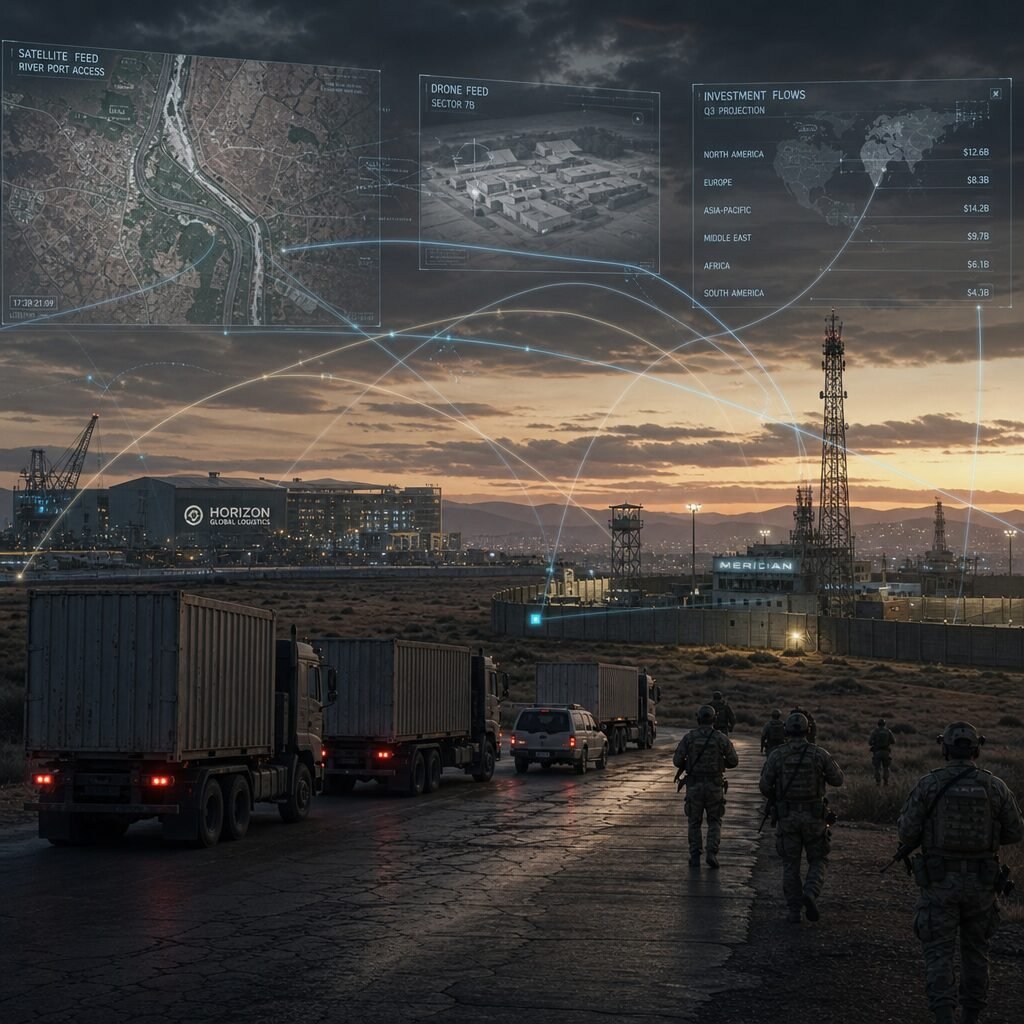
An unsettling market: why ‘demand’ for war is rising
When policy-makers and commentators talk about the rise of war they usually mean frequency, intensity or geographic spread. Less often discussed is the fact that war is increasingly treated, in practice, as a demand-driven phenomenon: various actors—states, corporations, investors, technicians and publics—now derive predictable material, political and cultural returns from conflict. That does not mean every actor wants open warfare everywhere; rather, a complex ecosystem has emerged in which incentives create persistent pressure for confrontation, escalation or sustained low-intensity violence.
This is not a simple binary of peace versus war. Demand for conflict can be economic (contracts, rents, reconstruction), technological (testing grounds, training data), political (nationalist legitimation, diversionary tactics) and cultural (media attention, entertainment exports). Together, these motives form a feedback loop: when it pays to prepare for, provoke or perpetuate violence, institutions and markets reorganise to supply it.
The industrial and financial engines: from PMCs to pension funds
Private military companies, defence contractors and logistics firms have matured into multi-billion-pound businesses with long-term profit incentives tied to persistent instability. Contracts for weapon systems, surveillance infrastructure and base support are not one-off transactions; they require recurring budgets, upgrades and geopolitical justification. The resulting lobbying and procurement cycles create what one might call a structural demand for conflict or at least for insecurity.
Equally striking is the role of capital markets. Sovereign wealth funds, private equity and even pension funds increasingly hold assets exposed to reconstruction, resource extraction and infrastructural rebuilding in fragile states. Those investors do not openly call for war, but their returns can be optimised when projects move from hypothetical to necessary. Insurance and reinsurance markets, meanwhile, price risk and sometimes make profit models contingent on protracted instability.
War as a laboratory: technology, data and the ethics of testing
Modern warfare provides an unparalleled environment for rapid iteration: drones, cyber tools, surveillance systems and autonomous weapons are stress-tested in real conflicts. Tech firms, from established defence primes to agile start-ups, benefit from battlefield deployments that yield performance metrics, user feedback and hard-won validation that cannot be replicated in peacetime testbeds.
Moreover, conflict zones are rich sources of data—visual feeds, signals intelligence, behavioural patterns—that are invaluable for machine learning models. The commodification of battlefield data creates a perverse incentive: access to conflict persists where data is plentiful. This raises ethical and regulatory questions about experimentation on populations and the outsourcing of violence to algorithmic systems. For further reading on the interplay between tech firms and conflict testing, see reporting by SIPRI and investigative pieces in major outlets.
Narratives and attention: how media and entertainment stoke demand
Conflict is attention-maximising. News cycles, streaming platforms and game studios all amplify and monetise narratives of threat, heroism and crisis. Real-world warfare feeds entertainment—films, series and video games—that in turn normalise militarised responses, shaping public appetite for confrontation. Social media accelerates this loop: graphic images, viral clips and targeted disinformation mobilise support or outrage that can be translated into political pressure.
The cultural economy around conflict is not incidental. Celebrity endorsements of combatants, militaristic branding, war-themed merchandise and immersive simulations create a cultural market that sustains demand for ever-more intense conflict stories. This soft power dynamic can be weaponised domestically to rally populations or internationally to attract proxies and funding.
Climate, scarcity and the new frontiers of demand
Environmental decline and resource scarcity are creating foreseeable theatres of competition—water basins, arable lands, Arctic routes. As states and corporations securitise access to resources, they generate incentives for militarised protection and pre-emption. This is demand by another name: the foresight that conflict could secure future profits makes investment in hard power rational today.
Climate-driven displacement also expands markets for border security, surveillance and humanitarian contracting. Firms offering solutions—from biometric camps to remote sensing—see growth tied directly to destabilisation. The humanitarian sector, too, is caught between assistance and market dynamics; large-scale aid logistics create long-term local dependencies that can blunt incentives to resolve root causes.
Policy leaks and the road to de‑risking demand
Acknowledging that demand for war exists does not equate to fatalism. Policy levers can alter incentives: procurement transparency, tighter controls on post-conflict reconstruction contracting, regulation of battlefield data flows and constraints on private military operations would reduce profitability. Financial regulation—such as disclosure requirements for investments tied to conflict zones—could rebalance capital incentives.
Crucially, cultural and media norms must shift. Platforms can change amplification dynamics by prioritising contextual reporting and penalising monetised disinformation. International institutions can make reparations, accountability and durable development more financially attractive than short-term rents. Until these levers are actively used, the hidden markets that profit from violence will continue to create a quiet but powerful demand for war.