
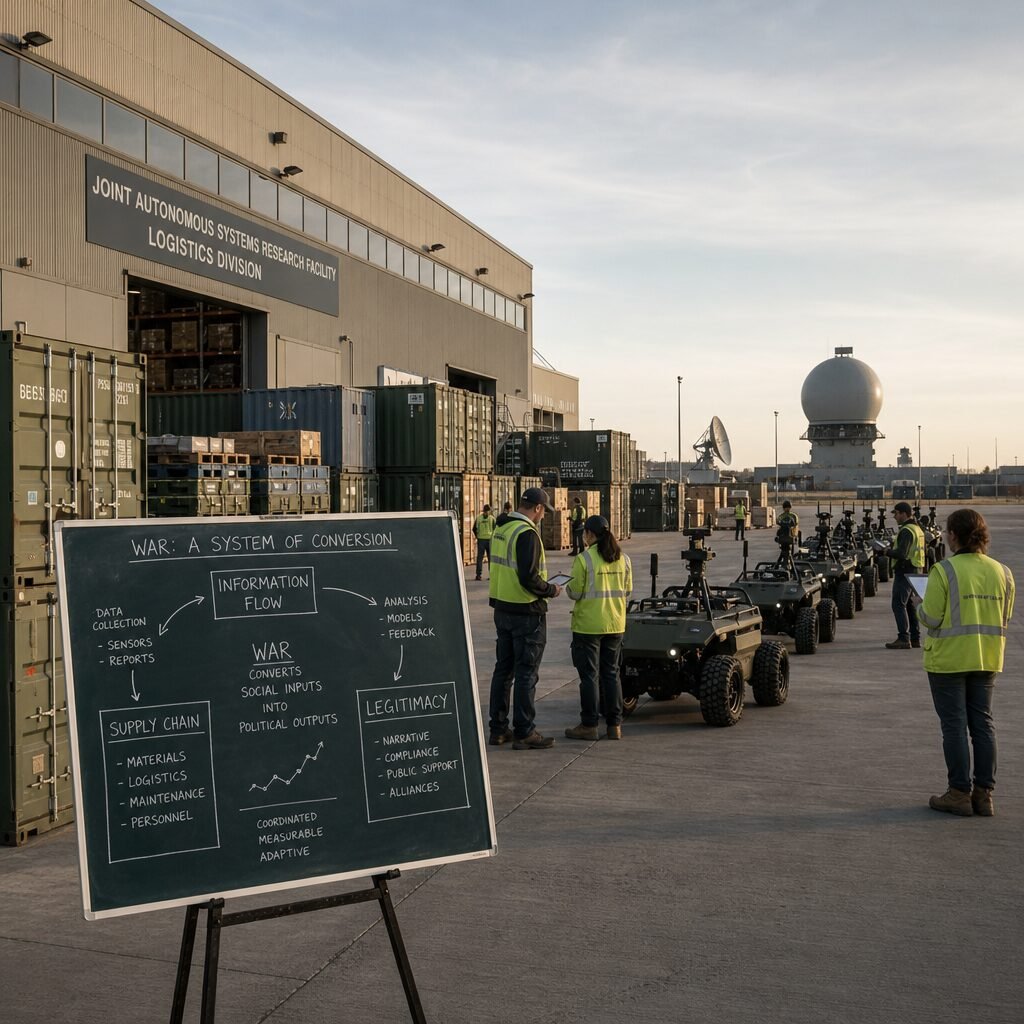
The Paradox of Efficacy: Defining Why War ‘Works’
War is often discussed in moral, political or strategic terms, but asking why war ‘works’ demands a scientific reframing: what mechanisms allow violence between polities to achieve coherent, repeatable outcomes? The short answer is that war is an engineered social technology—an information-processing, resource-concentrating and organisationally selected method for solving certain interstate and intrastate problems.
This section lays out the paradox: despite its brutality and unpredictability, war reliably produces outcomes that states and non-state actors seek—territorial change, regime replacement, deterrence, redistribution of resources, and rapid technological diffusion. To understand that reliability we must treat war as a system whose inputs (social structure, economy, technology) are converted into outputs (control, compliance, destruction) through measurable channels—logistics, command-and-control, intelligence, and signalling.
Selection and Organisational Evolution: Militaries as Adaptation Machines
Research in organisational theory and evolutionary biology helps explain why militaries become efficient at producing violent outcomes. Units, doctrines and technologies that survive combat are selected for replication; failures are pruned. Over time this creates high-performing organisms out of political inputs.
Empirical studies of army performance after major conflicts show rapid institutional learning: armies that suffered catastrophic defeats often reformed doctrine, training and industrial base in ways that produced measurably different outcomes in subsequent engagements. This is analogous to artificial selection in agriculture—war accelerates selection pressures on tactics, logistics and bureaucracy, weeding out inefficient practices and favouring structures that reliably move materiel and people under stress.
Information Theory: Fog, Friction and the Advantage of Organised Cognition
Claude Shannon’s information concepts and Clausewitz’s fog of war are complementary. War succeeds when one side reduces uncertainty more effectively than its opponent. Contemporary research in decision sciences shows that information advantage—not merely superior numbers—explains many battlefield outcomes.
Organisational cognition (rapid, hierarchical decision loops; distributed sensors; data fusion) converts noisy signals into actionable commands. This is visible across scales: from a commander using reconnaissance drones to a state leveraging SIGINT and economic indicators to anticipate adversary moves. Statistical models of engagement outcomes increasingly incorporate measures of information latency and quality; lower latency and higher signal-to-noise ratios correlate strongly with mission success.
Economics of Violence: Incentives, Subsidies and the Industrial Base
War ‘works’ because political economies can be reconfigured to privilege violent capacity. Economic historians have documented how wartime mobilisation channels capital, labour and innovation into military ends, often with persistent peacetime spillovers. Governments deploy fiscal tools—taxation, debt, subsidies and direct procurement—to concentrate resources rapidly.
Game theory clarifies incentives for allies and adversaries: coalition building, free-rider problems and deterrence equilibria shape resource commitments. Data from twentieth and twenty-first century conflicts reveal predictable patterns—industrialised states with large, flexible manufacturing sectors and deep financial markets convert economic input into military output more effectively, producing longer sustainment and higher operational tempo.
Narrative, Legitimacy and the Science of Compliance
Physical force is only half the story. The ability to legitimise violence—domestically and internationally—determines whether conquest leads to durable control. Social scientists studying propaganda, identity and compliance show that successful wartime actors create narratives that reconfigure loyalties and rationalise coercion.
Quantitative analyses of occupations and post-conflict governance demonstrate that legitimacy deficits increase insurgency risk and reduce the durability of gains. Conversely, actors that combine kinetic suppression with effective governance, public goods provision and information campaigns are statistically more likely to institutionalise their wartime gains. This interplay of coercion and consent is a measurable mechanism behind the apparent ‘success’ of wars.
Technological Convergence and the Changing Metrics of Effectiveness
Advances in missile accuracy, cyber capabilities, unmanned systems and communications have altered the mechanics of how war produces outcomes. The science of effects—how a precision strike, an information operation, or an economic sanction translates into political change—has matured into interdisciplinary research drawing on engineering, psychology and economics.
Data from recent conflicts show that precision and speed reduce collateral damage and political blowback, often enabling targeted coercion rather than total war. At the same time, cyber and information operations can achieve strategic effects without kinetic destruction, complicating traditional metrics. Understanding why war works now requires an integrated model of physical force, digital pressure and narrative influence—each with quantifiable parameters and measurable efficacy.
Implications: Predicting, Preventing and Designing Better Outcomes
If war’s efficacy rests on identifiable mechanisms—selection, information dominance, economic mobilisation, narrative control and technology—then policymakers and scholars can better predict when violent options will be effective and design interventions to prevent destructive outcomes.
Practical implications include investing in transparency to reduce surprise, strengthening institutions that lower selection pressure for militaristic solutions, and using economic levers to make war less attractive. The science does not moralise war away, but it does demystify it: by revealing the levers that make violence effective, societies gain the tools to make different choices.