
A New Meaning of ‘International’: When Borders Become Carbon Lines
When we say ‘international’ today, we often mean embassies, treaties and airlines. But beneath those familiar signposts lies another map: arteries of carbon and waste that trace the true flows of power and pollution. International trade corridors, tax havens, and flags of convenience have turned sovereign lines into highways for emissions, extraction and ecological displacement. This section reframes ‘international’ not as cooperation between polities but as infrastructure — legal, financial and logistical — that redistributes environmental harm away from wealth and towards vulnerability.
Carbon Highways: Shipping Lanes, Air Routes and Invisible Emissions
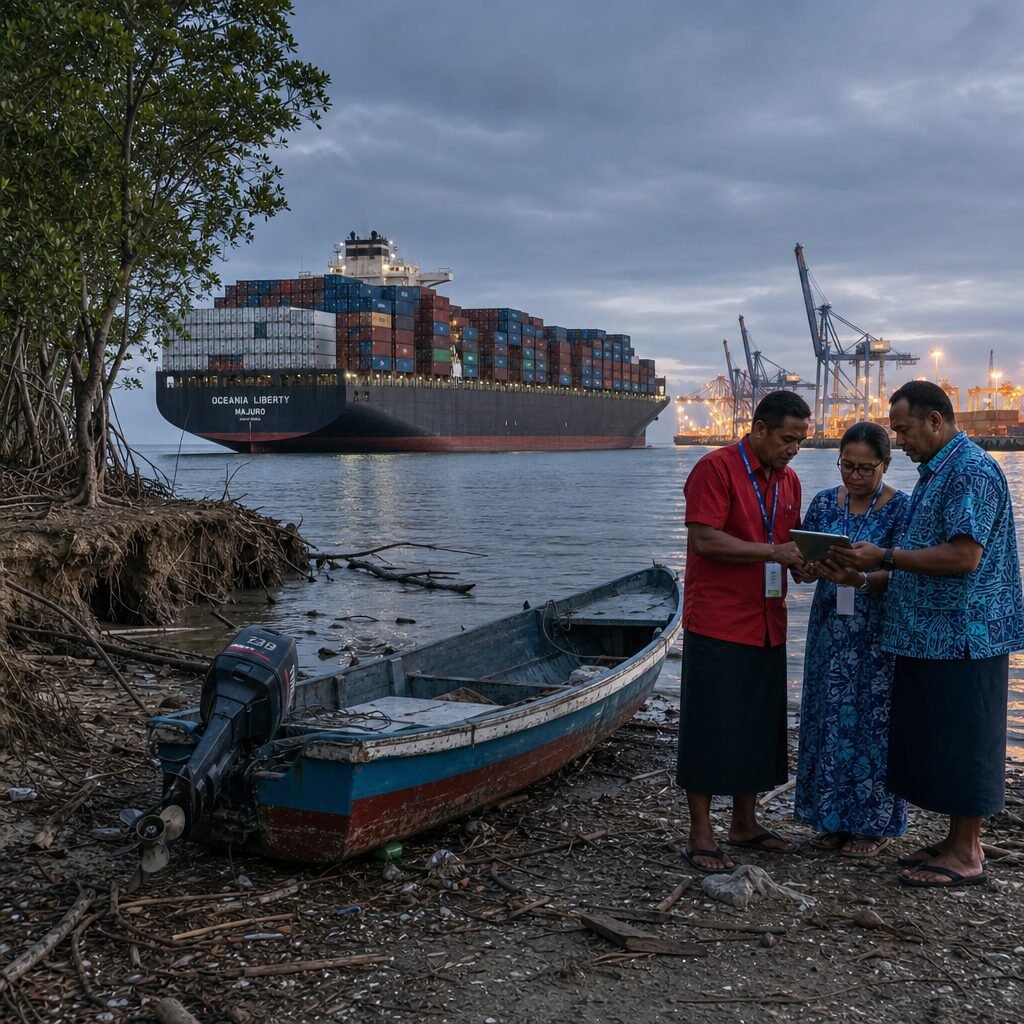
The global economy rides on a handful of chokepoints: the Panama and Suez canals, the Malacca Strait, major hubs like Rotterdam and Singapore. These are international spaces where one ship can dump more sulphur dioxide than a city in a week. The maritime sector remains one of the least transparent polluters because international law classifies ships by flag state, not owner. Owners register vessels in jurisdictions with lax environmental oversight, turning pollution enforcement into a game of jurisdictional hide-and-seek.
Aviation is similar. International law treats flights between states as transboundary acts, and carbon accounting often excludes international bunkers. The result: official national emissions figures undercount the footprint of traded goods and international travel. The contemporary ‘international’ has engineered regulatory blind spots that allow concentrated benefits for corporations and diffuse costs for coastal communities and the global South.
Regulatory Arbitrage: Flags, Havens and the Ecology of Evasion
Financial and legal instruments that enable multinational activity are themselves ecological actors. Tax havens and registry states offer legal shells that facilitate extractive projects with minimal oversight, from deep-sea mining contracts to pipeline concessions. This regulatory arbitrage creates a feedback loop: weaker scrutiny lowers operational costs, giving companies an incentive to offshore their environmental liabilities abroad.
The environmental consequences are not abstract. Offshore hydrocarbon leaks, seabed scarring from dredging, and biodiversity loss from unmonitored fishing are direct products of these internationalised legal decisions. Reining them in requires rethinking how international law assigns responsibility and how global markets price ecological risk.
Small States, Big Stakes: Island Diplomacy and Climate Sovereignty
Small island states offer a striking counterpoint to the evasive international system. For many, ‘international’ is existential: rising seas, coral bleaching and cross-border pollution threaten territory, culture and legal identity. These countries have pioneered reframing tools — from the legal concept of ‘climate refugees’ to creative maritime claims — that force the international community to see environmental harms as breaches of sovereignty.
Island diplomacy has produced surprising policy innovations that larger states often ignore: transboundary marine protection zones, climate-loss and damage funds, and regional carbon pricing tied to sea-level resilience. Their leverage lies less in GDP and more in moral authority and legal creativity, making them essential architects of a different, more accountable international environmental order.
New International Instruments: Carbon Clubs, Shipping Corridors and Green Clauses
Not all international mechanisms enable harm; some are being repurposed as repair tools. Carbon clubs — coalitions of countries or firms that set mutual carbon prices — aim to close leakage pathways by harmonising policy across borders. The shipping industry is experimenting with ‘green corridors’: routes where ships run on zero-carbon fuels supported by port infrastructure and aligned regulation.
Another emerging practice is the inclusion of environmental conditionality in bilateral and multilateral agreements. ‘Green clauses’ in trade treaties can oblige parties to meet ecological standards, while investment treaties increasingly include obligations for environmental due diligence. These instruments suggest a shift: instead of treating the international as a permissive space for arbitrage, policymakers can design it as a scaffold for decarbonisation and ecological justice.
Transnational Movements and the Cultural Geography of Sustainability
Beyond treaties and infrastructure, a quieter international is forming through culture and citizenship: diasporas demanding accountability for supply chains, cross-border Indigenous alliances resisting extractive megaprojects, and consumers using international platforms to shift corporate behaviour. These movements rewire the concept of international by connecting local harm to global buyers and financiers.
Digital organising accelerates this effect. A viral campaign in one country can force multinational retailers to change sourcing practices in another within days. In that sense, sustainability today is often international first — a networked accountability that outpaces slow legislative processes and targets the transnational ecosystems that enable environmental harm.
Rewriting the International: Practical Levers for a Sustainable World Order
If the international has been remodelled into corridors of carbon and zones of avoidance, then reform must be equally structural. Practical levers include: harmonised carbon accounting that internalises international bunker fuels and trade-embedded emissions; binding registry standards for shipping and corporate ownership; conditional finance from multilateral banks tied to biodiversity and community tenure; and expanded legal recognition for climate-displaced peoples.
These are not technocratic niceties but necessary shifts to align incentives with planetary limits. Reimagining the international as an accountable system — rather than an operational loophole — is a political task that combines law, finance and grassroots pressure. The stakes are territorial, moral and temporal: to make the word ‘international’ mean cooperation in sustainability, not the redistribution of ecological risk.