
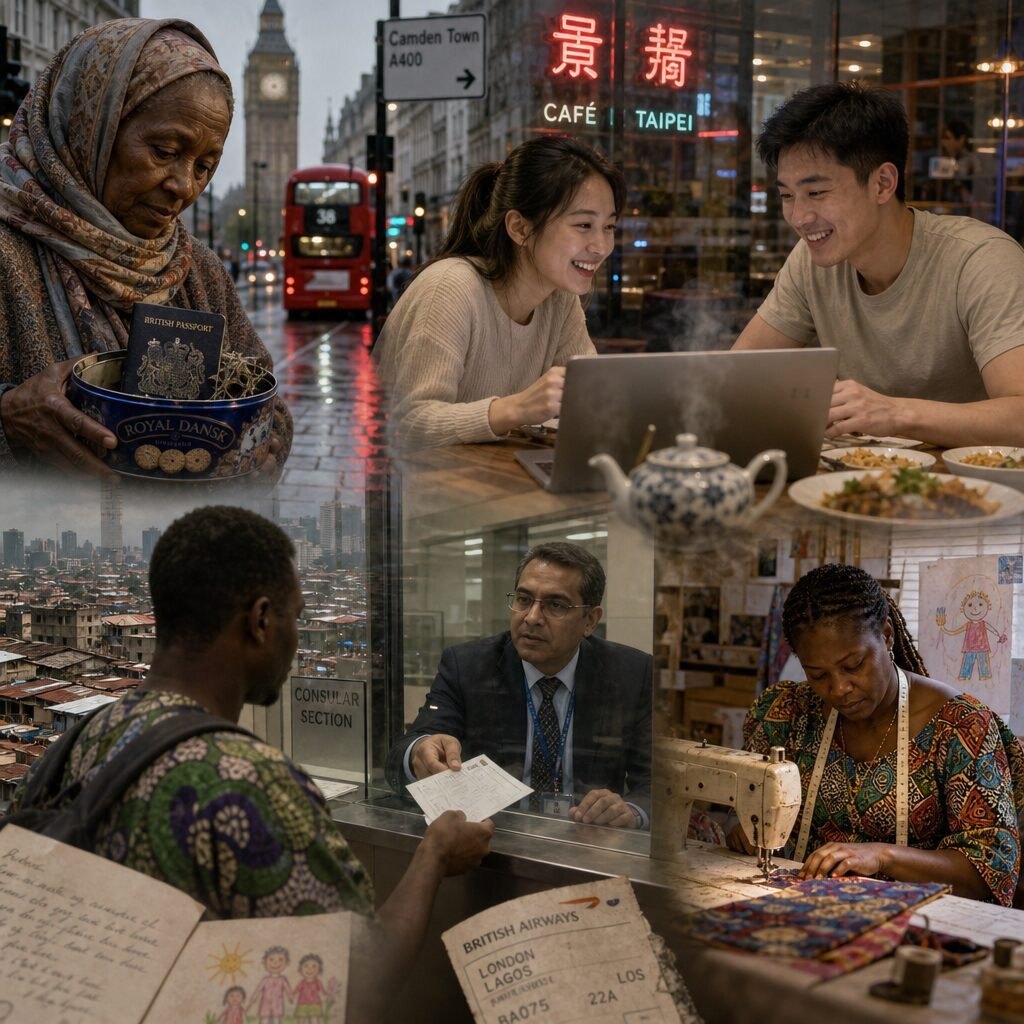
Passport as Heirloom: When a Document Becomes a Family Archive
For many, a passport is a travel necessity; for some families it is a living relic. In a council estate in Manchester, Amina keeps the battered passports of three generations in a biscuit tin. Each crease and stamp carries a story: a 1960s work permit from Cardiff to Lagos, a 1990s visa for a marriage that failed, a 2010 emergency stamp during a hurried evacuation. She treats them like photographs — curating who gets access, telling children the story behind each visa, using the stamps to explain why cousins live in Rome and cousins live in Kano.
Passports as heirlooms reveal how international lives are lived across time, not merely across borders. They codify moments of aspiration, desperation and pragmatism. For historians and anthropologists the worn pages are an intimate archive of migration pathways, but for families they are a mnemonic device: a way to anchor identity when homes are multiple and shifting. In practice, such documents shape rituals — Sunday storytelling over tea, ritualised visits to the immigration solicitor on birthdays — that ordinary coverage of ‘international’ affairs rarely captures.
Time-Zone Grief: Love Lives on Global Delay
Thirty years into a long-distance relationship, Javier from Seville and Mei from Shanghai measure anniversaries by time zones. Their daily ritual is a staggered dinner: Javier cooks at 20:00 CET, leaves a plate cooling by 22:00 when Mei logs on for a video call. Their grief is not dramatic; it is granular. Missing a scheduled bedtime chat becomes a discrete wound, a grief added to a ledger of missed spectacles and grandparents’ funerals watched on a screen.
There is a lexicon developing among such couples — ‘jetlag apology’, ‘timezone anniversary’ — that journalists seldom document. These small linguistic inventions are a coping mechanism and community signal. They create new social calendars: when a child is born, the family lists both the local time and the partner’s time, stating ‘born at 03:12 CEST / 10:12 CST’ as if to colour the birth certificate with the couple’s distributed geography. The personal logs of these lives suggest that international connection often creates new temporal architectures: living together across hours rather than in one place.
Consular Consoles: Small Offices, Big Emotional Work
A consulate in a mid-sized European city might be a single floor of an office block, but inside its rooms are concentrated dramas. Consular officers describe their role as ‘triage with paperwork’. They help a stranded student with no money catch a repatriation flight, issue emergency travel documents for a widow, or mediate between a seized passport and a frightened migrant.
These officers develop a distinct empathy: a practical, procedural kindness that attends to desperation without theatricality. Their notebooks are full of human contact details and the tiny rituals that help people breathe — ‘bring photos’, ‘call at 9’, ‘ask about mother’. Their stories complicate international relations; diplomacy is not only statecraft but also the mundane, daily work of returning someone’s lost earrings and orienting a refugee to local bus routes. This is the international as human-scale public service.
The Translator’s Intimacy: Between Languages, Between Lives
Translators live at the seams of international life, occasionally invisible but always intimate. A community interpreter in Brussels remembers translating for a Syrian father who finally said ‘I am tired’ and burst into tears — a phrase that in Arabic carried centuries of context that the translator learned to make visible in a few measured English words.
Good translation is not only linguistic fidelity but emotional triage: deciding what to soften, what to press, what cultural cues to foreground. Translators therefore curate memory and shape outcomes. In refugee hearings, medical appointments and love letters, they are custodians of trust. Their decisions — whether to retain a word like ‘shame’ in its original form or to paraphrase — alter how someone is perceived by officials, neighbours, or partners. Their work underscores that international encounters are not neutral exchanges but layered negotiations of dignity.
Diaspora Entrepreneurs: Building Bridges Between Economies and Identities
Across cities from Nairobi to Nottingham, diasporic entrepreneurs stitch economies together. Fatou from Dakar runs an online fashion hub linking tailors in Senegal to boutique stores in Marseille. Her supply chain is personal: she pays overtime wages to a seamstress whose family helped her when she first arrived, and she insists on ethically sourced fabrics despite higher costs. Her business is commerce and kinship intertwined.
These entrepreneurs act as translators of trust between markets. They navigate shipping rules, digital payments and cultural preferences, but they also manage expectations at home and abroad. Their success stories are not just economic; they reshape local job markets, alter gender roles and create new hybrid aesthetics. Reporting on GDP or trade balances misses this human engineering; it is in the emails, the shared invoices, the Skype calls at 01:00, where the international economy is actually written.
Rituals of Return: Homecomings That Rewrite Place
Homecoming is rarely a simple circle back. After fifteen years in Toronto, Priya returned to Chennai with a Canadian accent and a suitcase of practices: winter boots that sit unused, a habit of separating recycling religiously, a love of maple syrup. Her return transformed her neighbourhood’s Sunday morning routine; neighbours adopted her recycling bins, and a local café began serving pancakes with cardamom.
Returnees often act as cultural accelerants, bringing back attitudes and habits that catalyse local change. This is not always seamless — some face suspicion, labelled ‘too foreign’ by friends — but it complicates the simple narrative of migration as loss or gain. Instead, return is a palimpsest: the home rewritten with traces of other places, the local remade by things that came from abroad.