
Frontlines at Home: How Shared Risk Rewires Neighbourhoods
When artillery stopped being something that happened on a map and started being a background to daily life, people did not simply disperse. Instead, streets and stairwells became meeting points, and uncertainty became a new social glue. In cities under bombardment, neighbours developed routines — early-morning check-ins, pooled petrol runs, rostered repairs to blown-out windows — that outlived individual crises and recalibrated expectations of what neighbours owe one another.
These behaviours are not merely ad hoc survival tactics. Anthropologists and disaster sociologists have long observed that shared danger accelerates the formation of trust. Where bureaucratic services falter, informal governance emerges: wardens, volunteer clearing teams, and digital neighbourhood groups organise local logistics, allocate scarce resources and adjudicate disputes. The battlefield, in this sense, is both a literal front and a crucible for civic innovation.
Civic Infrastructure Reimagined: From Ruins to Cooperative Systems
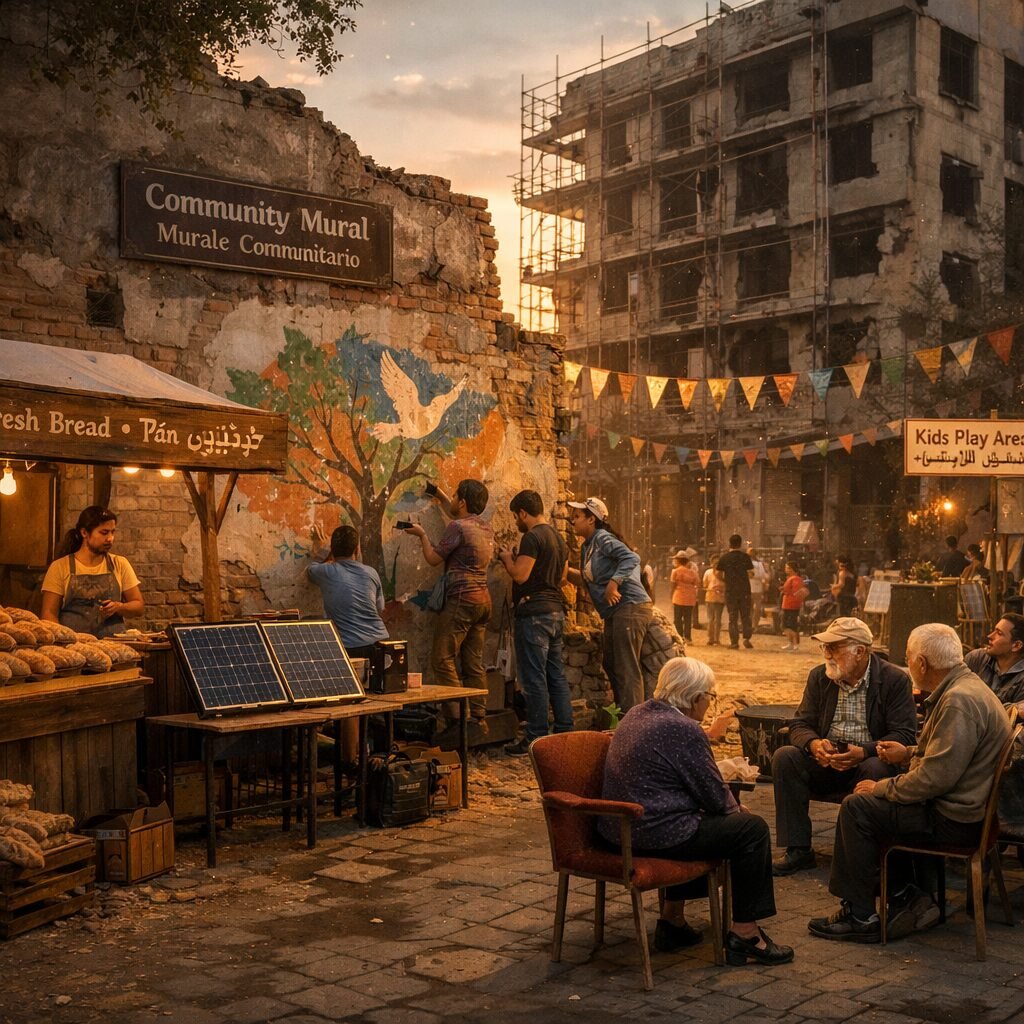
War damages pipes and powerlines, but it also exposes which systems truly matter. In the rubble of conflict zones, residents and returning diaspora often rebuild with a different blueprint: community-run bakeries, microgrids powered by solar arrays, and cooperatively managed markets that replace centralised supply lines.
These emergent infrastructures frequently prioritise redundancy and local control. Where supply chains are fragile, local production of essentials — bread, water purification, medical supplies — becomes a priority, spawning small enterprises and collective ventures. International NGOs may provide initial funding, but long-term resilience usually rests on local ownership models that embed maintenance knowledge within the community rather than relying on distant contractors.
Networks of Care: Mutual Aid as a Social Technology
One of the most persistent legacies of conflict is the codification of mutual aid. From informal ration-sharing to organised volunteer ambulances, wartime conditions popularise new technologies of care. Messaging apps and improvised radio networks become the nervous system for these efforts, while older institutions — churches, mosques, synagogues, civic clubs — often transform into logistics hubs.
Crucially, mutual aid during war is not a temporary charity; it is a social technology. Roles become institutionalised: first-aiders are trained, supply chains are mapped, and legal frameworks adapt to permit cooperatives and emergency committees. After the immediate conflict ends, these networks frequently pivot to peacetime problems — eldercare, youth employment, and urban planning — carrying forward a culture of reciprocity that changes civic expectations.
Memory, Ritual and Cultural Regeneration
Communities do not merely survive war; they narrate it into meaning. Shared rituals — commemorations at ruined squares, memorial gardening, and oral-history projects — knit individual loss into collective identity. These practices serve dual functions: they honour the past and create platforms for civic participation, renewing local arts scenes, school curricula and public discourse.
In several post-conflict towns, artists and cultural organisers have repurposed bombed-out spaces as performance venues and communal gardens, turning sites of trauma into places of learning and encounter. These symbolic transformations foster intergenerational dialogue and help reintegrate veterans and displaced people into everyday community life.
Transnational Ties: Diaspora, Remittances and Knowledge Flows
War often displaces populations, but displacement paradoxically extends community reach. Diaspora networks become critical nodes: sending remittances, lobbying internationally, and transferring technical know-how. These transnational ties can inject capital and skills into local rebuilding projects while also exporting civic models back to the homeland.
Unlike purely commercial investment, diaspora engagement tends to be relational and accountability-driven. Projects funded by expatriate groups — from school reconstructions to small hospital upgrades — are often curated through personal networks, which can produce high levels of responsiveness and long-term oversight. The result is a reconfiguration of community that spans borders and creates hybrid governance patterns combining local agency with global support.
Lessons for Peacetime Policy: Harnessing Wartime Social Capital
If war can catalyse cooperation, what prevents societies from institutionalising those gains in peace? The answer rests in policy choices. Governments and funders can either let wartime solidarity dissipate — absorbed by market pressures and bureaucratic inertia — or they can codify mechanisms that preserve community agency: legal recognition of cooperatives, seed funding for mutual-aid infrastructure, and participatory budgeting that channels post-conflict reconstruction through neighbourhood councils.
Practically, this means investing in local training, supporting community-led enterprises, and ensuring that international aid partners defer to local governance structures. The challenge is ethical as well as technical: to remember that the adaptive strengths forged in conflict are worth protecting, not exploiting. When policymakers treat wartime social capital as an asset for long-term civic renewal, the paradox becomes clear: out of the most destructive human enterprise can emerge renewed forms of social solidarity that reshape how communities govern themselves.