
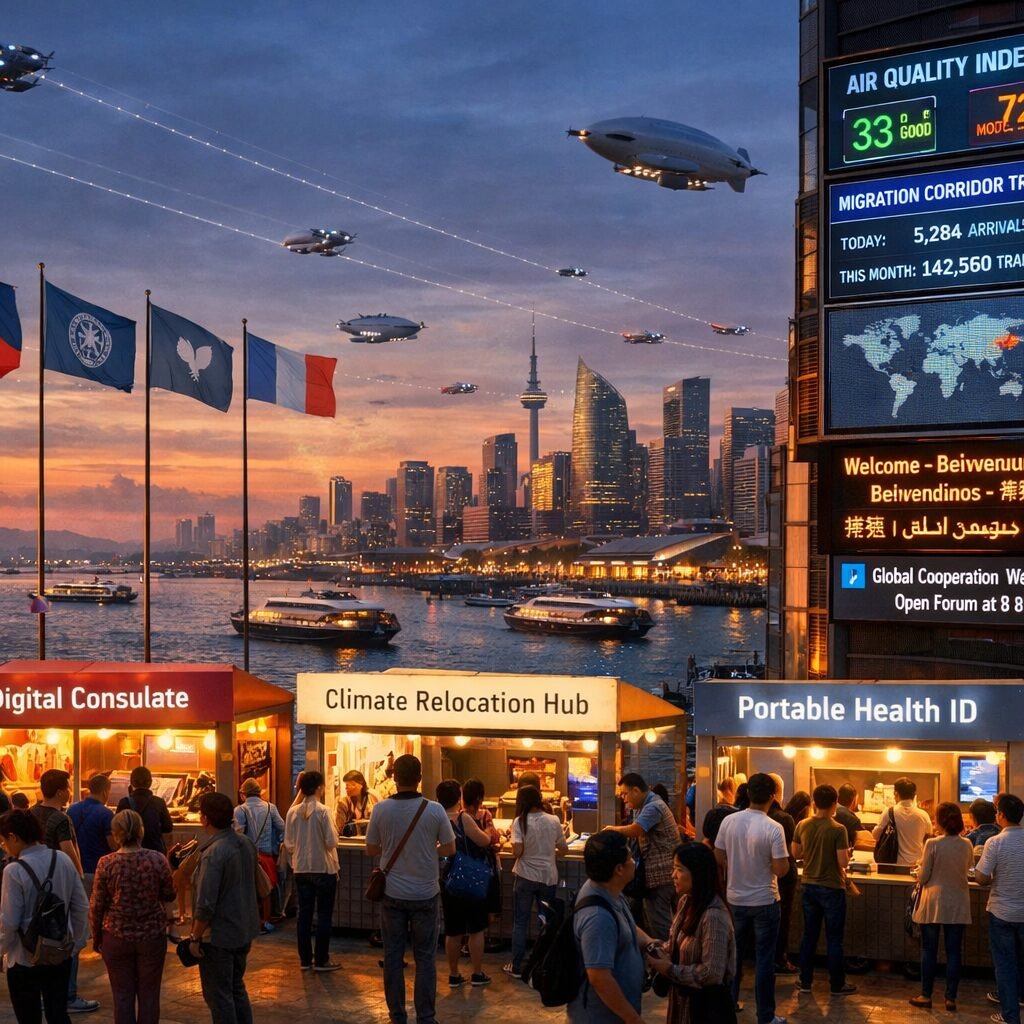
A different International: when borders become networks
The word “International” has long summoned images of nation-states, blue flags and treaty rooms. The next decade will see that imagery challenged not by a single revolution but by a slow redefinition: International will increasingly mean networks rather than rigid borders. This shift is not merely semantic. It is structural — a reconfiguration of authority, identity and accountability across overlapping public, private and digital spaces.
Cities, corporations, diasporas and online platforms already operate like states in many respects: they issue policies, provide services, lobby for recognition and curate cultural life. What is new is the degree to which they interlink to form cross-border ecosystems that solve problems faster than traditional diplomacy. Think mutual aid platforms that coordinate evacuations across continents, city-to-city climate compacts that bypass national bottlenecks, or corporations negotiating labour standards with coalitions of civic actors. In such a future, “International” will be a verb — the practice of coordinating across a mesh of authorities — rather than a noun reserved for states alone.
Subnational diplomacy: the city-state comeback
Subnational actors are staging a quiet comeback. Metropolitan regions already account for the majority of global GDP, and they increasingly treat one another as international partners. The practical drivers are obvious: climate resilience, migration management and supply-chain security require contiguous metropolitan responses that national borders can hamper.
Expect formalised networks of cities to deepen their institutional muscles: binding procurement agreements for renewables, cross-border transit authorities, and legal instruments for recognising professional credentials across regions. These arrangements will force national governments to share sovereignty on practical terms. Rather than a zero-sum loss of state power, this is likely to resemble a patchwork sovereignty where legitimacy derives from performance and consent within tightly scoped domains.
Corporate diplomacy and private treaty-making
Large corporations will not merely influence International affairs; they will write them. We are already seeing a proliferation of private rule‑making: tech platforms drafting moderation codes, shipping companies setting emissions standards, and retailers coordinating labour audits across suppliers. The next phase will include private treaty‑making between firms and public actors that create enforceable obligations across borders.
This presents both opportunity and hazard. Private actors can enforce standards faster than states, but they lack democratic accountability. The future International will therefore require new architectures of legitimacy: hybrid forums where civil society, regulators and businesses co‑author rules, and where private enforcement comes with transparent oversight and dispute-resolution mechanisms.
Digital embassies and algorithmic treaties
Digital diplomacy will mature into something that looks nothing like an embassy. Expect “digital embassies” — persistent, cross-platform presences that represent communities, regions or interests online. These will combine consular services, cultural outreach and regulatory engagement, operating in augmented spaces and metaverses as readily as on websites.
Parallel to this, “algorithmic treaties” will emerge: code-based agreements that bind parties through interoperable protocols rather than textual clauses. Imagine data‑sharing pacts enforced by cryptographic proofs, or environmental compacts where sensors automatically trigger mutual commitments. Such arrangements will speed cooperation but will also require literacy in code and standards of auditability to prevent opacity from becoming the new veto.
Climate displacement and the rethinking of borders
Climate change will force the most painful reappraisal of International. Rising seas, desertification and extreme weather will create flows of displacement that challenge the nation‑state model of citizenship. Rather than a mass, uniform crisis, displacement will be patchy and networked: seasonal labour rotations, climate-linked relocation corridors between cities, and multi-year resettlement programmes negotiated by consortia of hosts.
The policy innovation we should anticipate is the decoupling of rights from territory: portable social protections, mutual recognition of residency and work rights across regions, and new legal categories for climate migrants. These pragmatic steps will require moral and political imagination — and they will redefine what “International protection” means in practice.
Culture without gatekeepers: polycentric soft power
Soft power will stop radiating outward from capitals and begin to bubble up from multiple centres. Pop culture, sports, faith communities and niche tech ecosystems will project influence through networks rather than monologues. In this environment, culture becomes a web of micro‑influences: a film festival in Porto shapes a policy debate in Lagos; an online gaming league resets trade in digital goods across Asia and South America.
Governments will still act, but less as sole cultural stewards and more as conveners and guarantors of diversity. Cultural diplomacy will be collaborative, patching together public grants, platform partnerships and diaspora-led initiatives to create resilient, plural meanings of the International.
Risk, governance and the new legitimacy test
These shifts amplify opportunities but compound risks. Fragmentation can accelerate responses but also creates gaps where accountability dissolves. The test for the next International will be legitimacy: can hybrid institutions deliver public goods while remaining transparent and inclusive?
Success will look like layered governance: local and regional bodies solving practical problems, supported by international norms that are flexible and digitally enforceable, and underpinned by participatory mechanisms that allow affected communities to contest decisions. Failure will look like a proliferation of parallel regimes that privilege the powerful and deepen inequality.
Where it’s headed next: practical futures to watch
Three concrete trends will shape the immediate future. First, interoperable municipal compacts on climate and mobility that standardise emergency responses across borders. Second, legally binding corporate public‑interest obligations for platform ecosystems, including escrowed dispute systems and independent audits. Third, pilot schemes for portable social rights — portable pensions, cross-border health cards and recognisable professional licences.
Each is nascent today, but they share a common logic: International problems will be solved by coalitions that cut across state boundaries, combining local legitimacy, private capacity and digital enforcement. The hard political work will be designing those coalitions so that effectiveness does not come at the cost of representation.
Conclusion: learning to navigate a mesh
The future of International is not the end of nations but the emergence of a richer, messier mesh. Success will require new literacies — negotiating in code, convening across sectors, and designing accountability into hybrid institutions. It will also require humility from traditional powers and imagination from emergent actors.
Readers should take away a practical novelty: International, going forward, will be more local and more digital, more corporate and more civic. The question is not whether it will change, but who will build the scaffolding for that change and whether it will be shaped by democratic values or by concentration of power. The choices we make now will determine whether the next International is an inclusive architecture or a patchwork that privileges the already privileged.