
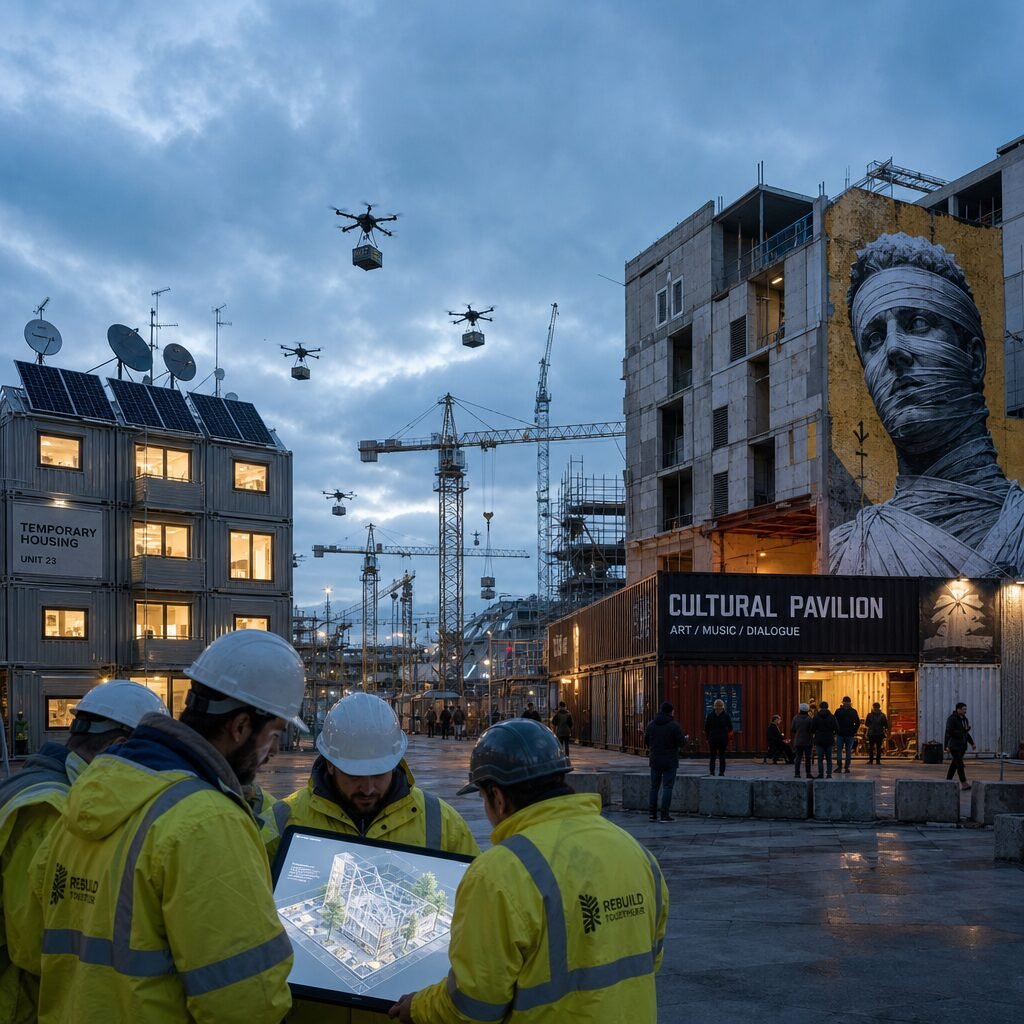
When War Becomes an Industry Innovator
War is usually framed as a rupture: lives shattered, cities razed, economies reordered. Less often noticed is how conflict accelerates and redirects innovation in ways that ripple through civilian industries for decades. This is not a celebration; it is an observation of technological, organisational and cultural transformations born of necessity. From satellite internet born of battlefield comms to rubble-sourced urban renewal, modern wars are rewriting the rules of product development, supply chains and even aesthetic sensibilities.
In the wars of the 21st century, front-line imperatives compress timelines and collapse risk aversion. Start-ups, defence contractors and public agencies find themselves in an odd, intense partnership that yields brittle but fast innovations. The consequence: technologies conceived for survival on the battlefield are re-entangled with civilian markets, changing industries in unexpected, sometimes uncomfortable ways.
Dual-Use Tech: From Tactical Kits to Everyday Tools
The dual-use phenomenon — technologies designed for military use that migrate to civilian life — is not new. What is new is the speed and scale of that migration. Drone reconnaissance and battery technologies scaled for conflict zones are now central to commercial logistics, agriculture and filmmaking. Low-latency satellite networks created to ensure resilient battlefield comms are being repurposed to serve rural broadband, disaster response and streaming media.
This flow is bidirectional. Consumer electronics innovation — lightweight batteries, machine vision algorithms, modular software stacks — increasingly feeds back into defence ecosystems. The result is an accelerated innovation loop: military needs turbocharge funding and testing, consumer markets provide scale, and both benefit from shared R&D. The ethical and regulatory friction this creates is profound; industries must navigate export controls, sanctions and public scrutiny while racing to capitalise on commercial opportunities.
Supply Chains Remade: Resilience as Product
Conflict exposes fragilities in global supply chains and forces companies to rethink logistics as a strategic product feature. Manufacturers that previously outsourced critical components now invest in ‘defensive reshoring’, inventory buffers, and diversified supplier networks. Logistics firms, reacting to wartime disruptions, prototype mobile warehouses, hardened transport corridors and crypto-secured manifest systems that later become competitive advantages in peacetime commerce.
Insurance and finance industries respond in kind. War-driven risk models — once confined to sovereign debt desks — migrate into corporate risk assessments, altering premiums and investment flows. In short, resilience becomes a sellable attribute, not just a contingency plan, reshaping procurement and consumer expectations across sectors from semiconductors to pharmaceuticals.
Creative Economies: Art, Memory and the Aesthetics of Repair
Wars also transform cultural industries. Artists, architects and designers confronting damaged urban fabric invent new vocabularies of repair. Galleries and theatres pivot to hybrid formats that were trialled as wartime adaptations — outdoor stages, pop-up museums in reclaimed industrial shells, virtual exhibitions that emerged when physical venues were unsafe. These formats persist because they expand access and reduce fixed costs.
A striking trend is the aestheticisation of repair: visible mending, adaptive reuse and rubble-derived materials become creative statements and marketable design choices. This both memorialises rupture and commodifies it, creating contentious dialogues about authenticity and appropriation. Cultural producers now straddle roles as documentarians, activists and entrepreneurs, turning sites of destruction into platforms for civic engagement and new revenue streams.
Urban Planning and the Reconstruction Economy
Post-conflict reconstruction is becoming an industry in itself, blending public policy, private capital and philanthropic funding. New models of urban planning emphasise modular, rapid-deploy housing and digital twins to simulate rebuilding scenarios. Private firms offer reconstruction-as-a-service, bundling design, logistics, financing and governance advisory. These firms leverage wartime-tested rapid procurement mechanisms and technology stacks.
This trend raises governance questions: who sets priorities when reconstruction is commoditised? When private actors lead rebuilding, social and cultural reparations risk being sidelined by efficiency metrics. Yet some municipalities are harnessing private-sector speed for public-good projects, using strict oversight and community engagement to steer outcomes. The reconstruction economy is thus both an opportunity and a test of democratic resilience.
The Long Shadow: Ethics, Regulation and the Normalisation of Conflict-Era Innovations
As conflict-born innovations diffuse, societies must contend with their long-term implications. Technologies that increase survivability can also lower the political cost of force; platforms engineered for rapid response can entrench surveillance. Regulators face a balancing act: fostering useful civilian spillovers while curbing militarised externalities. International law and export controls lag behind technological change, creating governance gaps that industry and civil society are scrambling to fill.
The challenge for policymakers, businesses and citizens is to ensure that the utility born in crisis does not entrench harm in peace. That will require transparent procurement, robust public debate, and a commitment to repurpose wartime ingenuity toward inclusive, accountable ends.