
Introduction: The Paradox of Cohesion in Conflict
War is typically framed as a force that shatters societies. Yet in the fissures it creates, new patterns of cohesion often emerge. This article examines how violent conflict—while causing immeasurable harm—can also catalyse the formation, reinforcement and reconfiguration of communities. Rather than romanticising suffering, the aim here is to identify the social mechanisms by which people organise to survive, rebuild and create enduring bonds.
Across different geographies and eras, these dynamics repeat: neighbours who once passed in silence become mutual aid partners; diasporas convert grieving into organised support; local economies rearrange to prioritise resilience. The following sections explore concrete pathways—social, economic, cultural and technological—through which war builds and strengthens communities.
Mutual Aid and the Everyday Networks of Survival
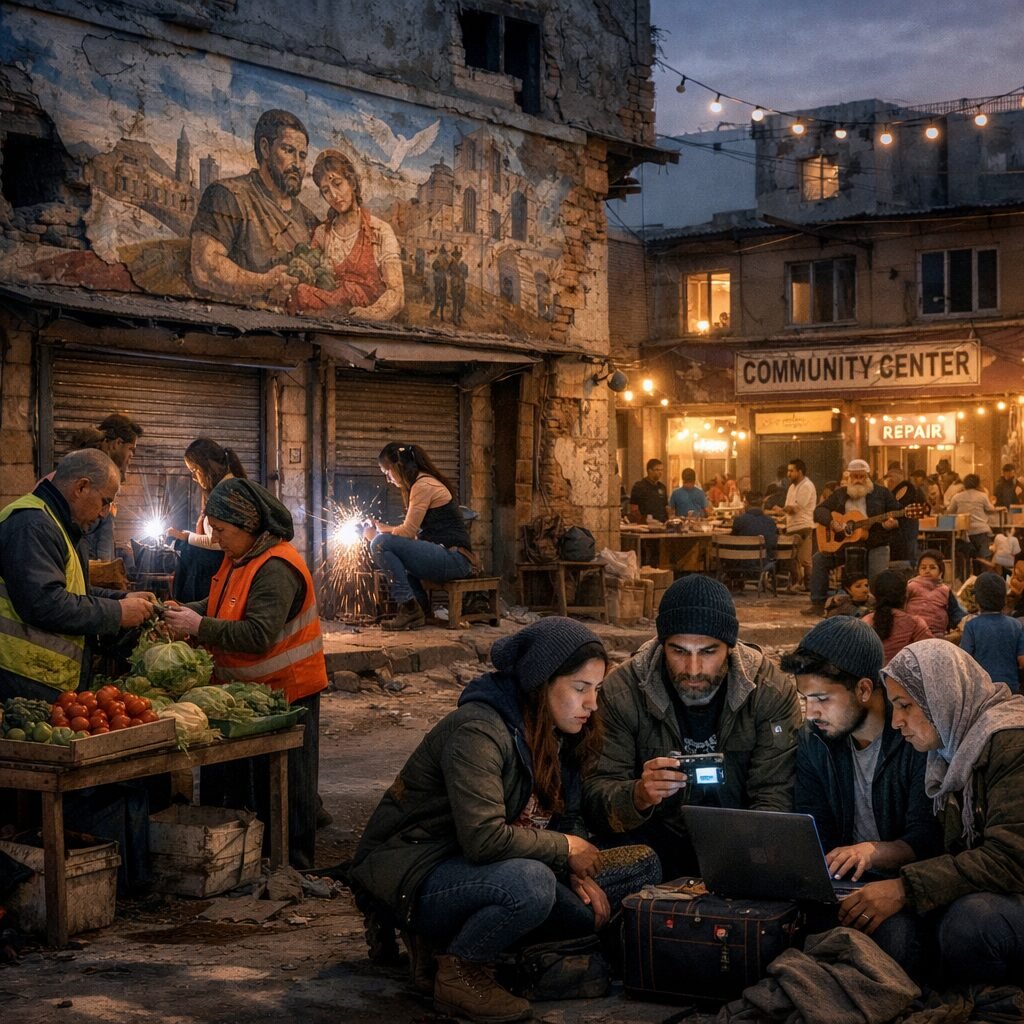
When formal institutions falter, informal networks step into the breach. Grocery-sharing partnerships, ad-hoc childcare collectives and neighbourhood first-aid teams form rapidly in wartime, turning scattered households into coordinated units. These networks are not merely survival mechanisms; they create trust capital. Shared scarcity produces repeated interactions, reciprocity and reputational norms that outlast immediate crisis.
Anthropologists who have studied civil wars note that these micro-level exchanges often institutionalise into longer-term organisations: committees for rebuilding, homeowner associations for shared repairs, or cooperatives to purchase supplies. In many cases, the same volunteers who ran a bomb-shelter rota will later run a community council meeting, translating wartime solidarity into peacetime governance.
Diasporas, Remittances and the Reinvention of Civic Life
Conflict frequently disperses populations, creating diasporas whose remittances and advocacy reshape the home communities they left behind. Money transfers are the most obvious channel, but equally important are social remittances—knowledge, organisational skills and political strategies transmitted back by migrants.
Diaspora organisations often fund schools, clinics and cultural centres, deliberately investing in institutions that knit society together. They also introduce civic practices—transparent budgeting, volunteer boards, participatory planning—that strengthen local governance. The result can be a hybrid civic ecology in which diasporic energy accelerates post-conflict reconstruction and embeds new forms of communal accountability.
Women as Architects of Community Resilience
Across conflicts, women frequently become the principal architects of household and community survival. Bearing the burden of care during male mobilisation, women innovate social services, organise food distribution and preserve cultural rituals that anchor identity.
Women-led networks often convert wartime roles into formal civic power. Community kitchens evolve into social enterprises, informal counselling groups into NGOs, and local education initiatives into accredited schools. This reconfiguration can alter gender norms—sometimes temporarily, sometimes enduringly—expanding women’s public presence and decision-making authority within rebuilding communities.
Cultural Preservation, Memory Work and Collective Identity
War accelerates concerns about loss—of language, artefacts, song—and prompts concentrated efforts to preserve culture. Community-led archives, oral-history projects and spontaneous street memorials become focal points for collective memory. These acts of preservation are not passive nostalgia; they are active community-building tools that define who belongs and why.
Memory work also frames post-conflict narratives, influencing reconciliation or retribution. When communities control their own commemorative projects, they can foster inclusive narratives that bind rather than fracture. Examples include neighbourhood murals that tell shared stories, communal festivals that reintroduce displaced groups, and participatory museums that create dialogue across generations.
Innovation and Local Economies: From Barter to Social Enterprise
Wartime scarcity forces economic innovation. Informal markets, barter networks and local currencies spring up to keep essential goods moving. These improvisations often outlive conflict, forming the backbone of more resilient, localised economies.
Entrepreneurial responses—repair workshops, cooperative bakeries, community energy schemes—frequently emerge from necessity and become institutionalised as social enterprises. Because they are rooted in shared need rather than pure profit, such ventures tend to redistribute benefits within the community, reinforcing mutual dependence and social cohesion.
Technology, Communication and Distributed Solidarity
Digital tools have changed how communities organise in wartime. Encrypted messaging apps coordinate evacuations and medical aid, crowd-sourced mapping platforms document damage, and online crowdfunding channels finance street-level interventions. Technology amplifies dispersed solidarity, turning geographically scattered supporters into effective local partners.
But digital organising also requires norms to sustain trust: verification protocols, transparent accounting and reputational systems. Where communities innovate robust governance around technology, they create durable institutions that mediate civic action long after the immediate crisis.
From Fighters to Citizens: Veteran Networks and Civic Reintegration
Combatants returning to civilian life bring with them organisational experience, leadership skills and tightly knit bonds. When channelled constructively, veteran networks can become pillars of community service—running emergency-response teams, training local security guards, or leading reconstruction projects.
Successful reintegration depends on reframing martial skills as civic competencies. Programmes that combine vocational training with community service opportunities convert military cohesion into positive social capital, reducing violence and strengthening communal safety nets.
Designing Peace: How Wartime Infrastructure Becomes Civic Infrastructure
Many wartime adaptations become permanent fixtures: rebuilt bridges become marketplaces; improvised shelters become community halls; wartime communication nodes become civic information centres. Planners who recognise the civic potential of these ad-hoc infrastructures can accelerate recovery by integrating them into participatory urban design.
This is a political as well as technical task. Prioritising community-managed spaces over top-down redevelopment preserves the social networks that emerged during conflict, ensuring that reconstruction reinforces rather than erodes local agency.
Conclusion: The Fragile Gains of Collective Repair
War is a crucible that both destroys and creates. The communities that emerge from conflict are products of extraordinary human adaptability: mutual aid networks knitted under fire, diasporas that fund and teach, women who convert care into civic leadership, and veterans who repurpose solidarity for civil ends. These gains are fragile—easily undermined by exclusionary politics, corruption or uneven reconstruction—but they offer a pragmatic pathway to durable peace.
Recognising and supporting the social architectures born in conflict is a matter of policy and ethics. International actors and local leaders alike should look not only at what war breaks, but at what it builds—and how those emergent structures can be nurtured into inclusive, resilient communities.