
Frontlines in Retail: Wargaming the Customer Journey
When retailers stage a “retail war” it is no longer about discounting alone but about rehearsing conflict scenarios in the customer experience. Major chains are borrowing military wargaming techniques — red teams, blue teams, and realistic tabletop exercises — to probe weak points in omnichannel journeys. These simulations place staff and systems in adversarial roles: one group acts as disruptive forces (supply shocks, cyber incidents, angry customers), while the other defends the customer experience, practising rapid decisions under pressure.
The result is a hardened storefront that feels effortless to the shopper. Teams that have rehearsed crises learn to reroute orders, communicate proactively, and preserve service levels with empathy. Rather than a grim fascination with combat, the metaphor of war becomes a disciplined rehearsal that reduces friction and builds resilient customer touchpoints.
After-Action Reviews: Learning Fast, Iterating Faster
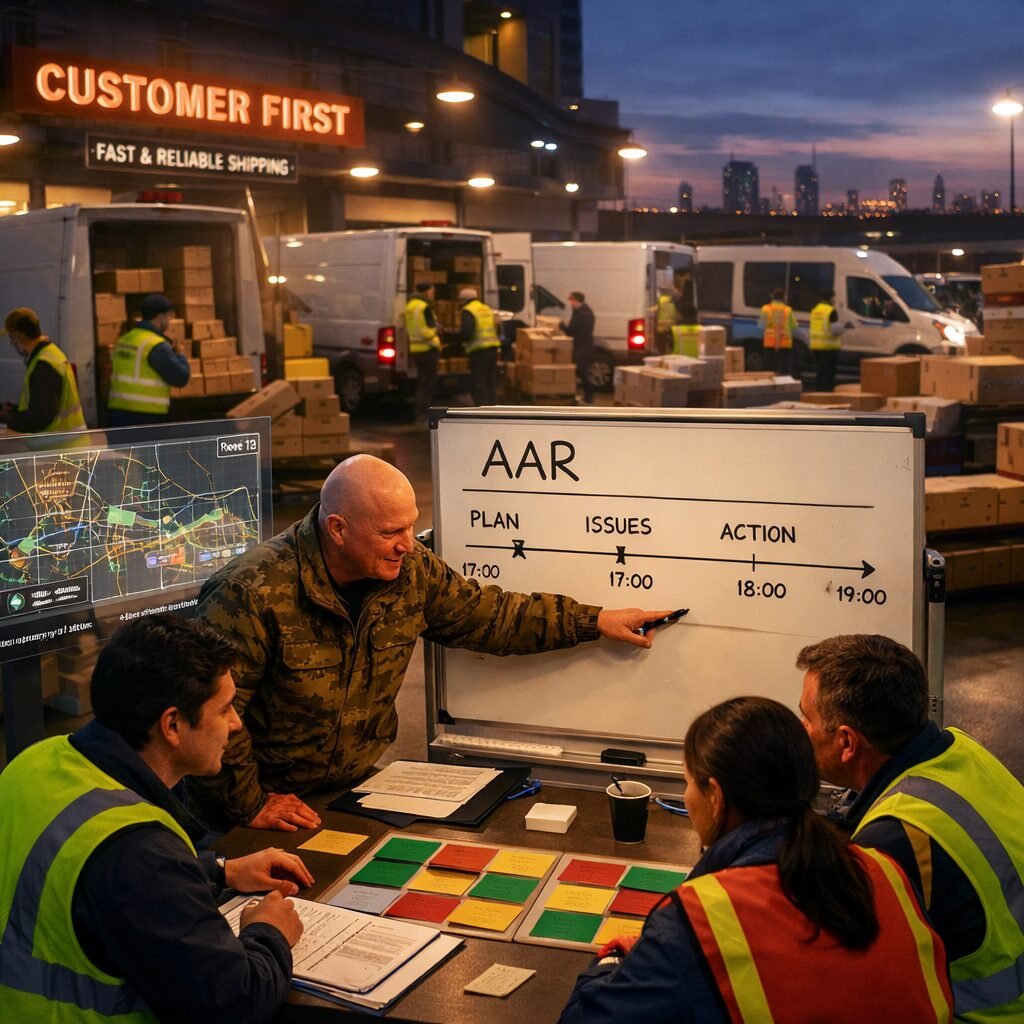
The military practice of the after-action review (AAR) — a structured debrief focused on what happened, why, and what to change — has migrated into customer-centred enterprises. Tech companies, airlines and hospitality groups use AARs after product launches, service outages and high-volume periods to extract actionable lessons.
Unlike standard post-mortems, AARs emphasise candid, non-punitive analysis and rapid iteration. Frontline staff, engineers and customer representatives sit together, review timelines and evidence, and immediately implement micro-experiments. Iterations measured in days or hours replace quarterly retrospectives. Customers notice the difference: fewer repeat failures, quicker visible fixes and a culture that treats complaints as intelligence rather than nuisances.
Logistics as Theatre: Military Supply Chains Inspire Seamless Delivery
Warfare has long driven innovations in logistics: precision supply, redundant routing and field improvisation. Companies from grocery to luxury fashion are adopting the same playbook to guarantee delivery reliability — the modern equivalent of ammunition reaching the front.
Businesses use layered inventories, mobile micro-fulfilment hubs and contingency carriers modelled on military redundancy. They run “convoy drills” for last-mile delivery where drivers, dispatchers and automated systems coordinate like platoons to maintain schedules during disruptions. For customers this translates into fewer missed deliveries, better real-time updates and the surprising ability to turn around impossible orders during peak demand.
Psychology of Conflict: Designing for Calm Amid Crisis
War teaches how people behave under threat: tunnel vision, stress responses and the need for clear command cues. Savvy customer experience designers incorporate these psychological insights to build calm into moments of friction.
Interfaces use clear, prioritised choices during outages; call centres employ scripts that mirror military brevity and reassurance; retail environments are organised with visible cues that reduce anxiety (queue marshals, simple signage, safe spaces). These adjustments reduce cognitive load and make customers feel cared for even when the situation is strained, fostering loyalty rather than frustration.
Ethics and Optics: When Martial Metaphors Backfire
Not every business can or should borrow the language of war. There is a fine ethical and marketing line between disciplined preparedness and glorifying conflict. Brands that overuse combative metaphors risk alienating customers or trivialising real suffering.
Leaders therefore translate military concepts into neutral language — resilience, rehearsal, contingency — and make transparency central. They also invest in peace-forward initiatives, pairing hardening activities with community support and employee wellbeing programmes. The goal is to harness the efficacy of martial methods while keeping humanity and humility in plain sight.
From Conflict to Care: The Future of CX Lessons from War
As geopolitical instability and climate shocks increase, customers will judge companies on how well they protect and serve them under pressure. The most prepared organisations will be those that have practised adversity with discipline, learned rapidly through AARs, and designed systems that prioritise calm and continuity.
Expect to see more cross-pollination: military logisticians advising retail roll-outs, veterans leading crisis teams, and experiential designers using battlefield realism to build empathy-led simulations. If handled thoughtfully, the paradox is that techniques born of conflict can make commercial life more humane — turning preparation for war into preparation for care.