
A Paradoxical Resource: Why Industries Mine War for Innovation
Across the globe, companies and public institutions are mining conflict — not its politics, but its technologies, data and logistical problem‑solving — to accelerate peacetime innovation. This repurposing is less about glorifying violence than about acknowledging that decades of military R&D created systems uniquely suited to extreme conditions: rugged engineering, rapid-deployment logistics, resilient communications and predictive analytics that model human behaviour under stress.
The paradox is simple. War concentrates resources and urgency; it compels engineers, medics and planners to solve problems with immediacy. Peacetime industries increasingly ask: how can we translate those solutions to civilian contexts? From disaster relief start‑ups adopting tactical drones to finance firms modelling market panic with wartime simulations, the lessons of conflict are being reframed as tools for resilience.
Healthcare: Battlefield Medicine Becomes Everyday Lifesaving
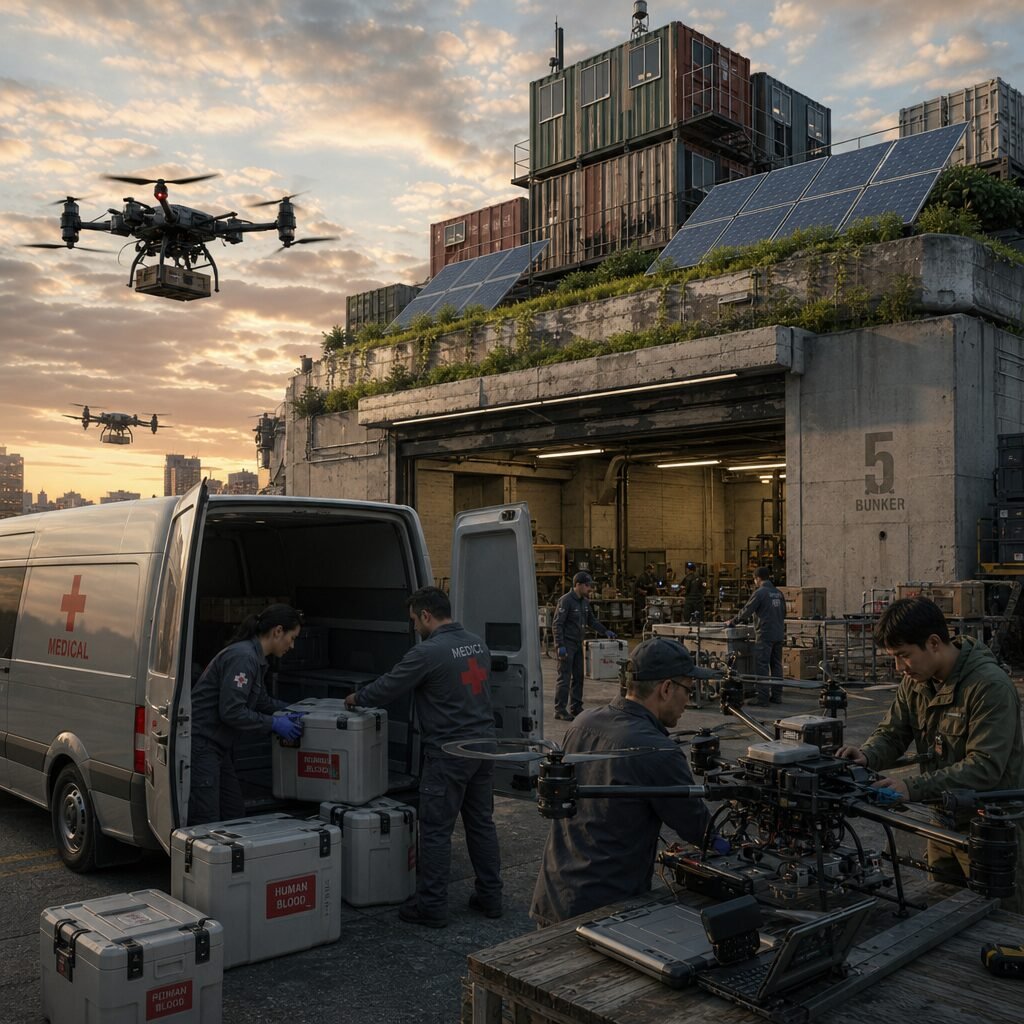
Modern emergency medicine owes much to battlefield advances. Tourniquets, haemostatic dressings and rapid triage protocols were refined in conflict zones and are now standard in ambulances and emergency departments. Hospitals and medtech companies are pushing further: portable blood storage systems originally designed for forward operating bases are being deployed to treat haemorrhagic stroke in rural clinics; telemedicine platforms built for medevac coordination are repurposed to connect specialists to isolated communities.
Another trend is surgical robotics and remote guidance. Systems developed to allow surgeons to operate from secure bunkers are now used to support complex procedures in regions lacking specialist surgeons. The ethical debate continues — especially around dual‑use technologies — but the immediate human benefits are tangible: faster response, more lives saved and medical access in places previously beyond reach.
Climate and Disaster Response: Tactical Logistics for a Warming Planet
Climate change is producing emergencies that resemble small wars: displaced populations, supply chain collapse and rapid infrastructure failure. Logistics companies are therefore adopting military doctrine — modular depots, airlift networks and mobile repair units — to respond to wildfires, floods and hurricanes.
Insurance firms use war‑grade damage assessment tools, like multispectral satellite imagery and rapid on‑the‑ground mapping tech, to speed claims and deploy resources. NGOs collaborate with defence contractors to create temporary shelters that fold down like armoured crates, offering durability against extreme weather. In effect, industries are saying: if war taught us to move fast under fire, those skills can prevent humanitarian crises from becoming catastrophes.
Technology and AI: Conflict Data Powers Predictive Systems
The data footprint of conflict — movement logs, sensor feeds, communications traffic — has spawned sophisticated analytic toolkits. Tech firms have adopted these toolkits to predict non‑military phenomena: supply chain disruptions, infrastructure failures and even consumer behaviour in crises.
Start‑ups trained models on conflict data to detect anomalous movement patterns; those models now help ports and logistics hubs identify bottlenecks before they cascade. Similarly, cybersecurity companies borrow red‑team techniques from military cyber units to simulate sustained attacks on critical infrastructure. The result is a class of predictive systems that anticipate instability, not to wage war, but to maintain continuity of service.
Urban Planning and Architecture: Fortifications Reimagined as Resilience
Cities once built walls to keep invaders out; today planners design urban resilience using the same principles but for different threats. Architects borrow from fortification — redundancy, compartmentalisation and layered defences — to create districts that can isolate failures without collapsing entirely.
A growing niche converts decommissioned bunkers and hardened facilities into community centres, data vaults and vertical farms. These conversions keep solid engineering while turning symbols of defence into civic infrastructure. Planners also integrate blast‑hardening techniques into public utilities to safeguard them from climate extremes and cascading blackouts, reframing military durability as civic robustness.
Fashion, Media and Culture: War Aesthetics, Reconfigured
The language of war has long influenced fashion and storytelling. What’s new is the ethical and functional repurposing of that aesthetic. Designers are collaborating with materials scientists who developed ballistic textiles to create everyday garments that are weatherproof, fire‑resistant and long‑lasting without being militaristic in appearance.
In media, producers use immersive storytelling techniques perfected in military training simulators to create empathetic narratives about refugees, first responders and survivors. These tools make distant conflicts emotionally proximate and spur civic engagement, fundraising and policy shifts. The aesthetic is no longer just about camouflage; it’s about endurance and visibility.
Finance and Insurance: Pricing Risk with War‑Grade Models
Markets hate uncertainty; war is the ultimate uncertainty. Hedge funds and insurers are importing scenario‑planning and stress‑testing methods from defence economics to price emerging systemic risks — pandemics, cyberwarfare, and climate tipping points. Insurers now use multifactor war‑style scenarios to model correlated failures across sectors, improving capital allocation and prompting businesses to invest in mitigation.
This cross‑pollination also spawns novel financial instruments: catastrophe bonds framed with geopolitical contingencies, and resilience credits that reward companies for adopting hardened supply chains. While moral hazards persist, the pragmatic outcome is smarter capital directed towards societal resilience.
Ethics and Governance: Regulating Dual‑Use Innovation
As civilian sectors adopt tools and techniques born in war, regulators face a pressing question: how to enable beneficial reuse while preventing misuse. Dual‑use technologies — drones, encryption, AI — require nuanced frameworks that balance innovation with restriction. Some jurisdictions are experimenting with licensing regimes, ethical audits and transparency mandates for companies repurposing defence tech.
Civil society groups call for stronger oversight and participatory governance, arguing that communities most affected by both conflict and climate must have a voice in how these technologies are applied. The emerging consensus: repurposing war can create public good, but only with accountability and democratic control.
Looking Forward: From Instruments of Destruction to Engines of Resilience
The industries adapting war‑born innovations are not glorifying conflict; they are harvesting hard‑won lessons in adaptation, speed and durability. That transformation — from instrument of destruction to engine of resilience — is neither automatic nor easy. It requires ethical guardrails, public engagement and a willingness to translate secrecy into open standards.
If handled responsibly, the surprising legacy of war may be a set of tools that help societies survive the existential stresses of the 21st century: climate shocks, pandemics, cyber disruption and mass displacement. The challenge will be ensuring these tools serve the many, not the few.