
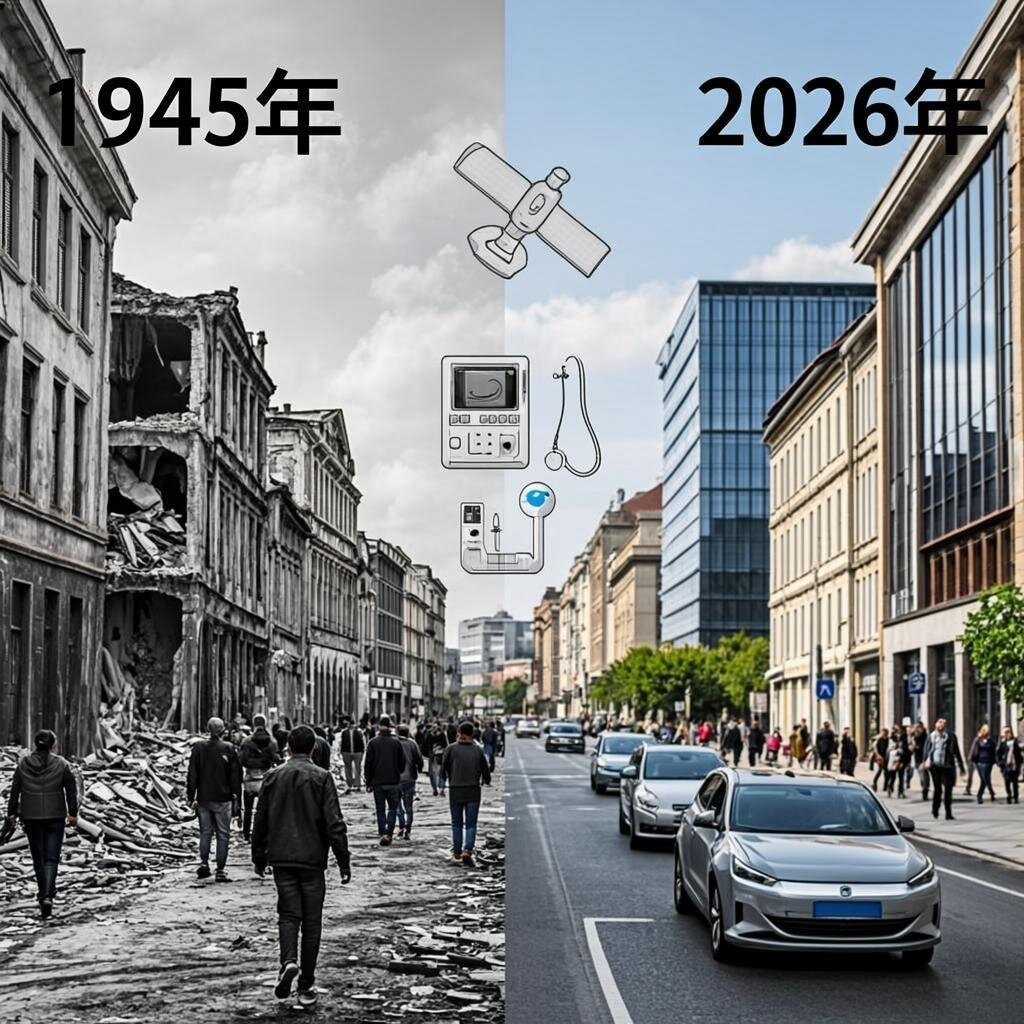
The Paradox at the Heart of Modern Peace
Walk through any modern European city today—Berlin, Warsaw, London—and you will find streets that were, not so very long ago, reduced to rubble. Yet beneath the regenerated pavements and glass-fronted offices lies an uncomfortable truth that we have collectively chosen to forget: the relative peace we now enjoy was not born from peace itself. It was forged in the fires of war.
We have become remarkably adept at treating war as something that happens elsewhere—a relic of history, or a tragedy confined to distant regions we glimpse on the evening news. But this comfortable distance is an illusion, and a dangerous one. War is not merely a destructive force that we should strive to eliminate; it is the hidden architect of much of what we consider civilised modern life. From the technology in our pockets to the medical treatments that save millions of lives annually, from the international institutions that govern global relations to the very concept of human rights, war’s fingerprints are everywhere—if we know where to look.
Acknowledging this is not to glorify conflict. It is to recognise that our relationship with war is far more complex and intimate than we typically admit, and that understanding this relationship is essential if we are to navigate the challenges of the 21st century.
The Technology We Inherit Without Question
Consider the smartphone in your pocket. That remarkable device represents the culmination of decades of innovation, much of it driven by military necessity. The internet—originally ARPANET—was a Cold War project designed to create a communications network that could survive a nuclear attack. GPS, the satellite system that guides everything from our delivery drivers to our dating app matches, was developed by the United States Department of Defense. Even the touch screen technology we now use to scroll through social media was refined through military research into more intuitive human-machine interfaces.
This pattern extends far beyond digital technology. Jet engine development accelerated dramatically during the Second World War. Radar, microwave ovens, synthetic rubber, and even certain plastics all owe their development or rapid advancement to military imperatives. The Defense Advanced Research Projects Agency alone has been responsible for breakthroughs that have transformed civilian life in ways its founders could scarcely have imagined.
The uncomfortable implication is this: many of the conveniences and capabilities we associate with peaceful modernity were originally conceived as instruments of war. This does not make them any less valuable, but it does suggest that the relationship between conflict and progress is more symbiotic than we typically acknowledge. War, for all its horrors, has historically concentrated minds and resources in ways that peacetime rarely achieves.
Medicine’s Debt to the Battlefield
Perhaps nowhere is war’s contribution to modern life more starkly visible than in medicine. The history of medical advancement is, in significant part, a history of responding to the carnage of conflict. Ambulances, triage systems, blood transfusion techniques, and the widespread use of antiseptics all evolved substantially through battlefield necessity. The Korean War saw the development of mobile army surgical hospitals (MASH units) that revolutionised trauma care. The Vietnam War drove advances in treating severe burns and developing prosthetics.
More recently, the conflicts in Iraq and Afghanistan led to extraordinary improvements in treating traumatic brain injuries, managing post-traumatic stress disorder, and developing increasingly sophisticated prosthetic limbs. These advances, born from the suffering of soldiers, now benefit civilians worldwide—car crash victims, accident survivors, and those living with disabilities.
This creates a moral complexity that is difficult to navigate. We are, in a very real sense, beneficiaries of others’ suffering. The treatments that save lives in peaceful hospitals today were often perfected in circumstances of extreme violence. Recognising this does not diminish the value of these medical breakthroughs, but it does demand a more honest reckoning with the costs of progress.
The Institutions That Keep Us Safe
The United Nations, the European Union, the Geneva Conventions, the international human rights framework—none of these emerged from a vacuum. Each was a direct response to the catastrophic wars of the 20th century, born from a collective determination that never again should the world witness such devastation. The very concept of crimes against humanity, enshrined in international law, was articulated during the Nuremberg trials in the aftermath of the Second World War.
The European Union, often celebrated as a triumph of peaceful cooperation, was fundamentally a project to make another war between France and Germany materially impossible by intertwining their economies, particularly in coal and steel production. The UN Security Council’s structure, with its five permanent members wielding veto power, was designed to reflect the geopolitical realities that emerged from the Second World War and to ensure that the world’s most powerful nations had a stake in maintaining international order.
These institutions are imperfect—often deeply so—but they represent humanity’s most ambitious attempt to construct a framework for managing conflict without resorting to the catastrophic wars that preceded them. The danger we now face is that, as the memory of those wars fades, so too does our commitment to the institutions they inspired. Across Europe and beyond, nationalist movements question the value of international cooperation, often oblivious to the fact that this cooperation was purchased at the cost of millions of lives.
The Danger of Forgetting
There is a well-known observation, often attributed to various military strategists, that generals are always fighting the last war. But there is a more insidious problem that afflicts civilian populations in times of extended peace: the tendency to forget that war matters at all.
This forgetting takes many forms. It manifests in the casual way political leaders invoke military solutions to complex problems, apparently unburdened by genuine understanding of what military engagement entails. It appears in the public’s willingness to accept the erosion of international norms and institutions, as if these structures were not hard-won defences against chaos. It is visible in the growing normalisation of rhetoric that dehumanises entire populations—a psychological prerequisite for the worst forms of violence.
The year 2026 finds us in a precarious position. The post-Second World War order is under unprecedented strain. Conflict has returned to European soil. Tensions between major powers are rising. The institutions designed to manage international relations are being questioned as never before. Yet public discourse often treats these developments with a detachment that suggests we have forgotten why those institutions and norms existed in the first place.
War matters not merely because of its direct consequences—though these are catastrophic enough—but because it shapes everything that follows. The world we inhabit, with all its imperfections and achievements, was profoundly moulded by the wars of the past century. If we lose sight of this connection, if we allow ourselves to believe that peace is the natural default state rather than something actively constructed and maintained, we risk repeating the very mistakes that led to the conflicts we now study in history books.
The challenge for our generation is not simply to prevent war, but to understand it—to grasp why it has mattered, why it continues to matter, and why the fragile peace we enjoy is far more contingent than we would like to believe. Only by confronting this uncomfortable truth can we hope to build a future that does not require another catastrophic conflict to remind us of war’s enduring significance.