
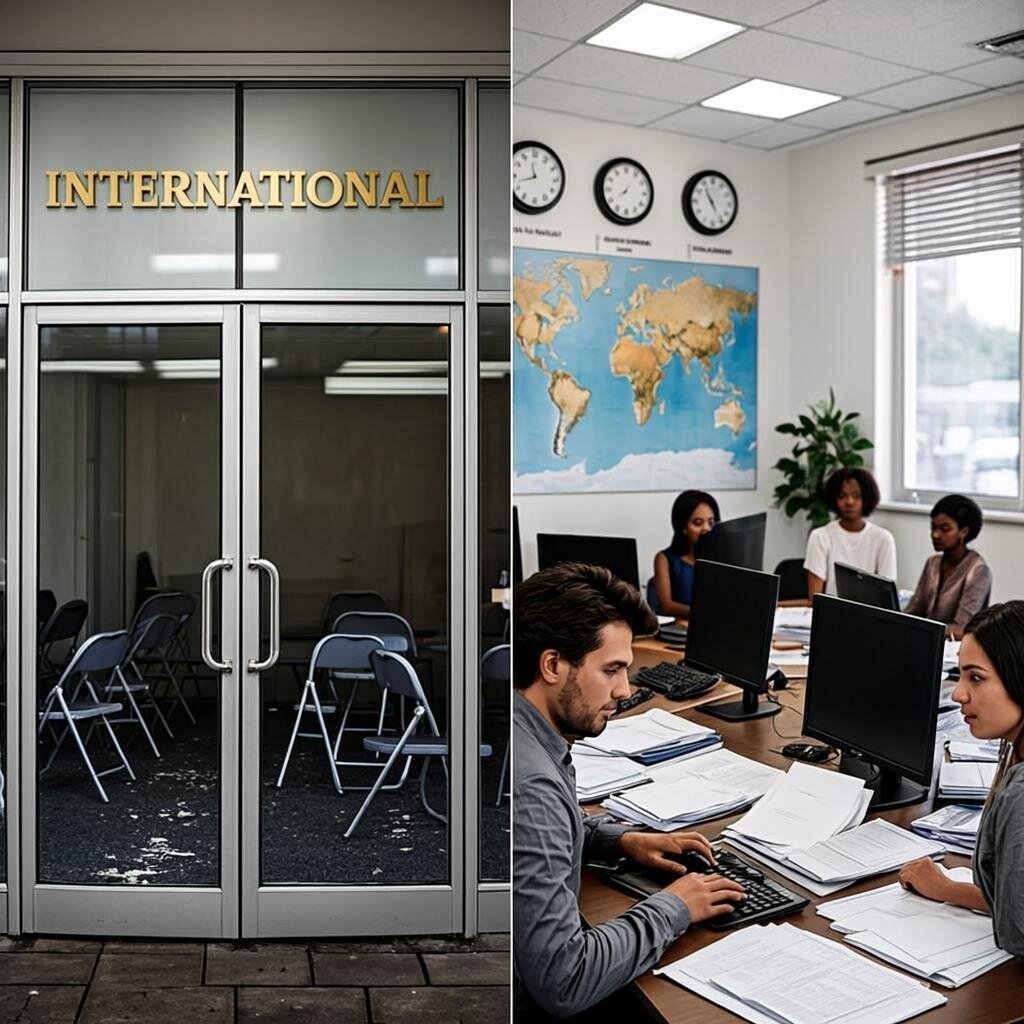
The ‘International’ Premium Tax
We’ve all seen it: a product, service, or institution that slaps the word ‘International’ onto its branding and suddenly commands a 40% price premium. In 2026, as global connectivity reaches unprecedented levels, the term has become less a descriptor and more a marketing weapon. The global ‘international’ labelling market is estimated to be worth upwards of $2.3 trillion, encompassing everything from education to consumer goods. Yet remarkably, no regulatory body anywhere in the world polices the use of this word. Anyone can use it. And they do.
The problem has reached such proportions that the Consumer International Protection Consortium (CIPC) published a landmark study in March 2026 revealing that 67% of products and services bearing the ‘International’ label in their branding had no verifiable international credentials, supply chains, or oversight. The figure was highest in education (78%) and lowest in logistics (31%). What this means for the average consumer, business owner, or prospective student is stark: you are likely paying for something that doesn’t exist.
The Education Illusion: When ‘International’ Means ‘Expensive’
Perhaps no sector has been more thoroughly corrupted by the meaningless use of ‘International’ than education. Across Asia, the Middle East, and increasingly in Eastern Europe, ‘International Schools’ have proliferated at an astonishing rate. The International School Consultancy reported in early 2026 that over 14,000 institutions worldwide now use the designation, up from just 2,500 in the year 2000.
The red flags here are numerous and telling. Genuine international schools typically belong to recognised accreditation bodies such as the Council of International Schools (CIS), the Western Association of Schools and Colleges (WASC), or offer recognised curricula like the International Baccalaureate (IB). However, investigation reveals that approximately 40% of schools using ‘International’ in their name hold no such accreditation. They operate as private national schools with a foreign-sounding name and an inflated fee structure.
Parents should be particularly wary of institutions that cannot produce documentation of their accreditation status, whose teaching staff lack international qualifications, or whose university placement records are opaque. A genuine international school will proudly display its affiliations; a fraudulent one will deflect with marketing language about ‘global citizenship’ and ‘international-mindedness’ without substantive backing.
Conference Predators: The Pay-to-Play ‘International’ Circuit
The academic and professional conference circuit has developed its own parasitic ecosystem. Predatory conference organisers have recognised that attaching ‘International’ to an event title lends an aura of legitimacy that attracts submissions and attendance fees. These events, often hosted in attractive locations, promise publication in ‘international journals’ and networking with ‘global experts’.
The reality is frequently far less impressive. Investigations by journalism students at the University of Manchester in 2025 uncovered a network of conferences held in three-star hotels where the ‘international’ speakers were flown in from neighbouring countries, the publication fees were exorbitant, and the peer review process was non-existent. One researcher described attending an ‘International Conference on Sustainable Development’ in Vienna where 80% of attendees were from the host country and the keynote speaker was the organiser’s spouse.
Red flags include conferences with submission deadlines that seem perpetually extended, acceptance notifications within days of submission, venues that are hotels rather than academic institutions, and organising committees whose members cannot be verified through institutional websites. Legitimate international conferences are typically affiliated with recognised academic bodies, have rigorous review processes taking weeks or months, and are hosted by universities or established professional organisations.
The Supply Chain Mirage
In the world of commerce, ‘international’ has become a shorthand for quality that often bears no relationship to actual standards. A survey conducted by the Trading Standards Institute in 2025 found that products labelled as ‘internationally sourced’ or ‘international quality’ were no more likely to meet safety standards than domestically produced alternatives. In some categories, particularly electronics and cosmetics, they performed worse.
The issue stems from what supply chain experts call ‘origin opacity’. Companies exploit the fact that ‘international’ implies foreign origin without specifying which foreign origin. A product marketed as ‘international’ might contain components from twelve countries, assembled in a thirteenth, with quality control in none of them. The lack of specific origin information is itself a red flag. Reputable companies operating internationally are typically transparent about their supply chains, not because they are legally required to be in most jurisdictions, but because genuine international operations are something to showcase, not obscure.
Consumers and business buyers should look for specific country-of-origin markings, ISO certifications, and supply chain transparency reports. The absence of these, combined with vague ‘international’ marketing language, should trigger suspicion.
Business Partnerships: Spotting the Hollow ‘International’
For businesses seeking to expand globally, partnering with firms that describe themselves as ‘international’ carries significant risk. The designation suggests cross-border experience, multi-jurisdictional expertise, and established networks. Too often, it means none of these things.
A genuine international business partner will have verifiable operations in multiple countries, references from clients in those jurisdictions, and staff who demonstrably work across borders. They will understand regulatory differences, currency implications, and cultural nuances. The ‘international’ pretender, by contrast, will have a website translated into multiple languages but no actual presence in those markets. They will claim ‘global reach’ but cannot provide case studies from outside their home country.
Due diligence questions should focus on specifics: In which countries do you have physical offices? What percentage of your revenue comes from international clients? Can you provide references from clients in three different jurisdictions? Vague answers or deflections should be treated as serious warnings. The cost of entering a partnership with a fraudulent ‘international’ firm extends beyond financial loss to reputational damage and potential legal liability.
The Verification Toolkit: A Practical Guide
Developing the skills to distinguish genuine international operations from marketing fiction requires a systematic approach. The first step is always to look for specificity. Genuine international entities provide specific information: countries of operation, accreditation bodies, regulatory jurisdictions, and verifiable credentials. Vagueness is the hallmark of fraud.
Second, verify independently. Do not rely on the entity’s own website for claims of international status. Check accreditation body databases, regulatory filings in claimed jurisdictions, and professional registries. The internet has made this verification easier than ever, yet remarkably few people conduct it.
Third, examine the network. Genuine international operations have international connections that can be verified. Their staff have international backgrounds visible on professional networks. Their clients and partners are themselves international. An ‘international’ organisation whose entire network is domestic is not international, regardless of its branding.
Finally, trust your instincts when something feels performative rather than substantive. Real international experience is complex, nuanced, and sometimes messy. It involves navigating different regulatory environments, cultural expectations, and business practices. If an entity’s ‘international’ nature seems too smooth, too polished, and too effortless, it probably isn’t real.
The Future of ‘International’: Regulation on the Horizon?
As awareness of the ‘international’ labelling problem grows, regulatory attention is beginning to focus on the issue. The European Union is reportedly considering guidelines that would require companies using ‘international’ in their branding to demonstrate verifiable cross-border operations. Similar discussions are underway in Australia and Singapore.
However, regulation alone will not solve the problem. The global nature of commerce means that bad actors will simply relocate to jurisdictions with lax oversight. The most effective defence remains an informed consumer and business community that demands evidence over assertion.
The word ‘international’ should mean something. It should signify genuine cross-border experience, multi-jurisdictional understanding, and established global networks. When it becomes mere marketing wallpaper, everyone loses except the fraudsters. By learning to spot the red flags and demanding substantiation, we can begin to reclaim the term and ensure it once again represents something meaningful.