
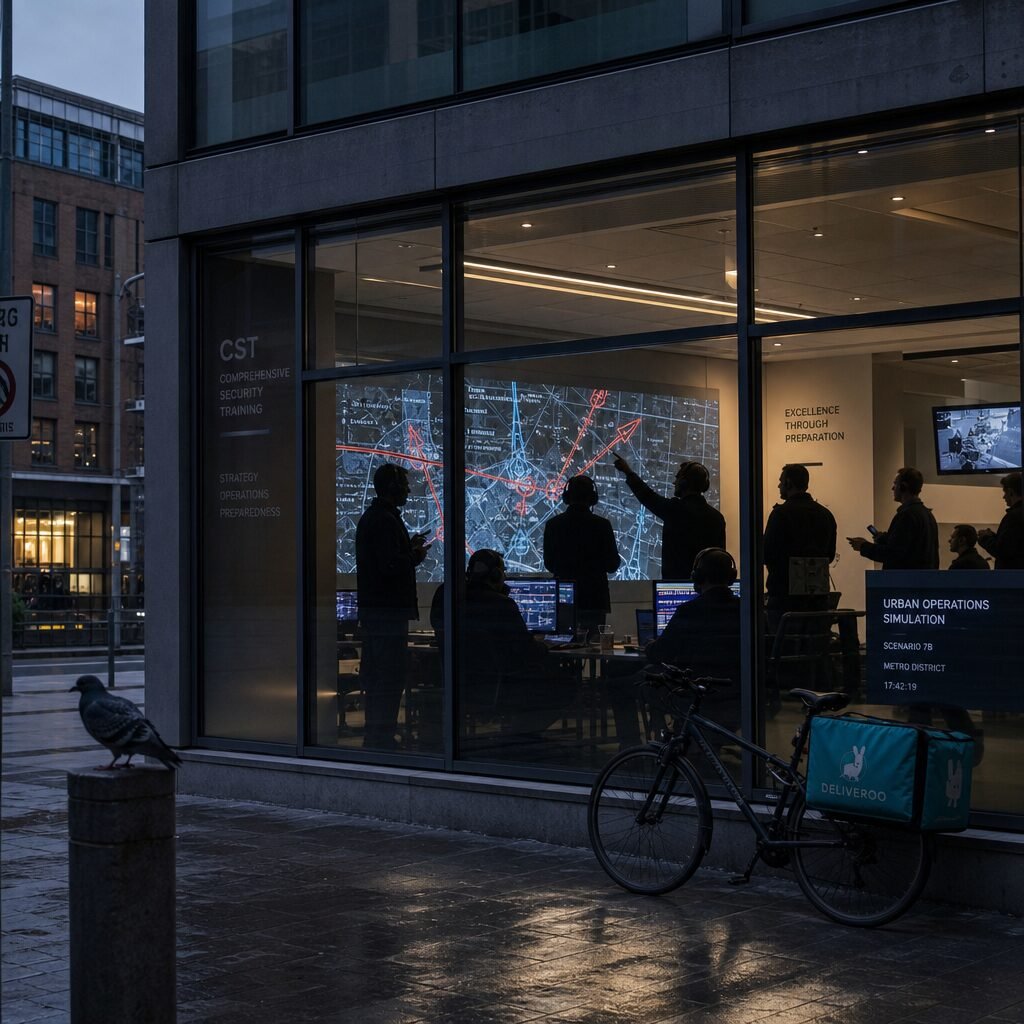
War as a Product: Reframing Conflict for Commercial Gain
When businesses ‘offer War’ they are not merchandising violence; they are packaging controlled conflict as a service. Over the last decade a discrete market has emerged around simulated confrontation — from corporate war‑gaming and adversarial cyber exercises to immersive retail ‘battle’ experiences and competitive sports-as-service. These offerings turn the ancient logic of conflict into a commercial proposition: stress‑testing organisations, accelerating learning cycles, and crafting memorable brand theatre.
This reframing rests on a simple premise: in a safe, bounded setting, war becomes the most efficient teacher of weakness. Corporations pay to be attacked by their own hired Red Teams; customers queue to take part in staged urban VR skirmishes; investors fund start‑ups that sell deliberate market disruption as a consultancy. The appeal is paradoxical — by offering conflict, companies promise protection and performance.
Competitive Edge Through Deliberate Adversity
Deliberate adversity sharpens competencies faster than comfort. Red Team/Blue Team exercises borrowed from military practice have migrated into finance, healthcare and critical infrastructure. For firms able to offer this expertise as a repeatable product, there are three business advantages: rapid product validation, demonstrable resilience, and a reputational halo.
Rapid validation: Simulated attack surfaces accelerate discovery of systemic flaws. An insurer who sells cyber‑resilience policies and pairs them with breathing exercises for clients sees claim frequency drop — a measurable ROI that wins market share.
Demonstrable resilience: Firms that can show they have survived orchestrated stress scenarios command higher trust from regulators and customers. That trust translates into premium pricing and longer client relationships.
Reputational halo: Brands that stage compelling conflict experiences — whether through immersive entertainment or transparent stress tests — create narratives that stick. They become known as fortifiers rather than mere vendors.
Monetising Conflict: Business Models and Productisation
There are multiple ways to monetise offering War. The direct model sells the exercise itself: workshops, simulations, live‑action events, or cyber‑warfare drills. The subscription model embeds ongoing adversarial testing into a client’s lifecycle. Platform models provide marketplaces for third‑party challengers to test products at scale. Hybrid approaches mix insurance, consulting and training into bundled offerings.
Productisation requires repeatability and metrics. Successful vendors quantify damage averted, response time improvements, and customer sentiment shifts. Those KPIs turn a dramatic, qualitative experience into a boardroom sell. Consider Gartner-style research that equates ‘days to recovery’ improvements with reduced churn; clients buy in because the business case is explicit.
Ethics, Regulation and the Risk of Normalising Conflict
Offering War is not risk‑free. There is an ethical tightrope between legitimate resilience work and the normalisation or glamourisation of violence. Businesses must navigate consent, safety standards, and psychological harm mitigation. Clear ethical frameworks, independent oversight and adherence to standards — both legal and psychological — are essential.
Regulators are already circling. Data protection, occupational safety and emerging AI governance all bear on how far simulated conflict can be pushed. Firms that anticipate regulation and build transparent rules into their products gain an early‑mover advantage; those that rely on shock value may find themselves shut out.
Beyond Survival: Strategic Benefits for Organisational Culture
Offering War reshapes internal culture as much as external propositions. Employees exposed to constructive conflict tend to develop higher psychological safety when debriefs are handled well — paradoxically, regular encounter with simulated danger fosters trust and honesty. Teams that have fought together against designed adversaries often report clearer decision protocols, faster escalation paths and improved cross‑functional empathy.
For executive teams, the practice of hosting controlled conflicts becomes a leadership laboratory. Choices made under pressure reveal latent biases and process failures in ways tabletop exercises cannot. Companies selling that laboratory experience provide a deeper, stickier service than traditional training vendors.
Case Studies: When Offering War Paid Off
A European energy firm contracted an independent adversarial group to simulate a coordinated cyber‑and‑physical attack. The exercise revealed a vendor dependency that would have paralysed operations; after mitigation, the firm renegotiated supply contracts and avoided an estimated €150m in potential losses.
A boutique marketing agency built a subscription ‘brand skirmish’ product where client campaigns were intentionally sabotaged in safe spaces to test viral resilience. The result: campaigns that survived sabotage were 30% more likely to achieve sustained engagement, and the agency doubled retention among risk‑averse clients.
These are not fictional anecdotes but indicative outcomes: monetised conflict can produce measurable commercial benefits when executed responsibly.
How to Start Offering War Without Becoming a Warlord
Begin with clear boundaries: define objectives, consent parameters and safety protocols. Invest in debriefing capabilities; the learning moment is in the aftermath, not the attack itself. Build modular products that scale from tabletop to live action, allowing clients to choose intensity.
Partner with neutral auditors and mental health professionals. Publish outcomes and methodology to demonstrate legitimacy. Finally, tell the story honestly: selling resilience through conflict is a higher‑order proposition that requires trust — the same trust you claim to protect.